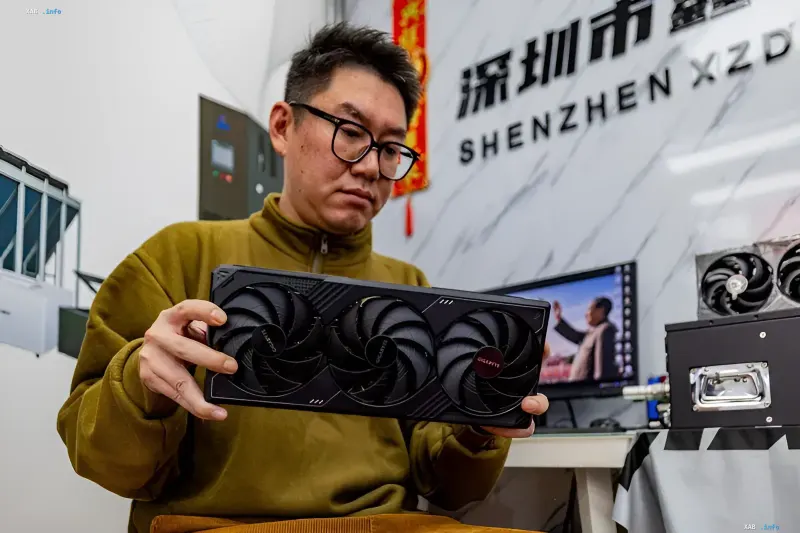
Despite current US export restrictions, it is still possible to purchase the latest Nvidia accelerators, intended for artificial intelligence systems, relatively freely in China. Journalists from The Washington Post personally verified this by visiting the famous Huaqiangbei electronics market in Shenzhen and negotiating the purchase of so-called "banned" hardware. As their visit showed, the matter is not limited to scarce graphics cards: in one of the pavilions, vendors were offering servers equipped with eight Blackwell B300 accelerators—a configuration that would be "completely unthinkable" to see on the open market for American lawmakers.
Open trade in "banned" accelerators
According to the vendors, the cost of such a server with eight B300 units is about 20 million yuan, equivalent to approximately $3 million. For comparison: the estimated price of a similar configuration in the US is valued at $500,000–$600,000. At the same time, Nvidia does not publish official retail prices for its most powerful accelerators, which makes the gap between legal products and items of unknown origin, particularly in terms of the supply chain, truly impressive. The journalists, however, could not directly buy or inspect the server products: they were satisfied with the promises of intermediaries and photographs of boxes containing unknown contents.
Prices inflated by rumors of Huang's resignation
Vendors explain the abnormally high price by the "hype" surrounding Jensen Huang's dismissal from the head of Nvidia: according to them, after the resignation, the market for scarce products began to "fever" even more than due to US sanctions, and before that, a similar server cost about $2 million. Now, with Huang's return to a leadership position, the market expects a decline and stabilization of the company's product prices. As for consumer and professional graphics cards, the vendors were eager to demonstrate them: journalists saw RTX 5090s and professional RTX PRO 6000 accelerators directly at the retail outlets. One vendor admitted to receiving RTX PRO 6000s via Hong Kong but could not explain the entire supply chain; according to the traders, server versions of AI accelerators arrive through complex chains, including via Hong Kong—however, all this remains just the words of intermediaries.
Who buys and why
Traders from Huaqiangbei do not hide the fact that buyers from other countries often come for Nvidia chips: over the past five years, there have been many citizens of Russia and Iran among their clients, and as the sellers note, "if people bring money, they always find what they are looking for." Chinese authorities, according to observations, do not particularly hinder the sales of Nvidia products within the country, although there is a certain contradiction here between the desire to "throw off the shackles of sanctions" and the desire to develop their own national technologies. On the other hand, the high prices for Nvidia products and the difficulties in obtaining them legally stimulate the emergence of close analogs from local companies—for example, Ascend AI accelerators developed by Huawei. Analysts are confident that Nvidia chips are a "decisive factor" in the competition between the US and China in the field of artificial intelligence, which explains Washington's attempts to stop their shipments.
"Disorder and confusion" in US export control
To a certain, and perhaps significant extent, American authorities and regulators are themselves to blame for the current situation, journalists believe, explaining this by "disorder and confusion" in both the Trump administration and the agencies responsible for export control. The severity of the situation is highlighted by documents published on November 19, 2026: the US House Foreign Affairs Committee released materials on the licensing of Nvidia and AMD accelerator shipments to China. According to them, the US Bureau of Industry and Security (BIS) approved more than 879,000 applications for the export of AI accelerators from both companies, with a total volume of requested shipments of about 3.4 million devices. Separately, The Washington Post established that almost 580,000 approved Nvidia accelerators belonged to the H200 family.
Shadow of a spy scandal surrounding Huang
The amorous-spy adventures of Jensen Huang added extra edge to the situation. His alleged affair with Singaporean citizen Alice Huang, who was reportedly recruited by Chinese intelligence services, raised concerns about the creation of a well-established supply network for sanctioned chips and accelerators to China or their transfer to leased facilities. However, the presence of Nvidia accelerators at Chinese merchants does not in itself prove that the company directly supplied them in circumvention of restrictions: Nvidia denies knowingly violating American bans. Thus, The Washington Post investigation records a persistent gap between the formal export control regime and the actual practice of trade in the largest electronics market in South China.