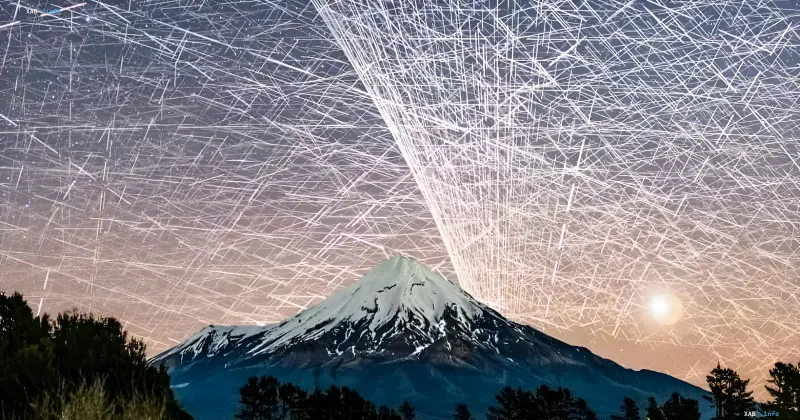
The night sky over Mount Taranaki on New Zealand’s North Island became the center of international attention after 51-year-old astrophotographer Brendan Larsen posted a panoramic image on social media showing a dense web of light streaks woven above the snow-capped peak. The image captures approximately 1,400 satellites and around 14,000 light trails, forming a complex geometric structure against the sunset sky. The work, composed from hundreds of individual shots, quickly garnered tens of millions of views and brought the author 15,000 new followers in just a few days.
578 frames and forty hours of retouching
According to Larsen, the shooting took place in September 2026 and lasted exactly two hours: the photographer took 578 consecutive exposures, each eight seconds long, with two-second pauses between them. "That was the easy part," he admitted. Much more time was spent on post-processing: in Adobe Photoshop, Larsen spent forty hours layering the frames, manually removing stars to highlight approximately 25 satellites in each shot. It was this multi-layered composite technique that allowed for the final picture, where thousands of orbital objects assemble into a single visual network.
Viral fame and AI allegations
Mid-October became a turning point for Larsen: posting the photo on social media triggered a landslide of reactions. Alongside admiration came numerous comments from viewers claiming the image was generated by AI. Larsen admitted he understood the logic behind such suspicions against the backdrop of rapidly developing generative models, yet expressed frustration that his work had already been uploaded into AI services and recreated with obvious artifacts and errors.
Video as proof of authenticity
To put questions about the photo's origin to rest, the photographer documented the entire creative process on video: from setting up equipment and the series of exposures to the step-by-step work in graphic software. The timelapse video demonstrates every stage of the composition. Larsen explained that he hopes for two results: refuting allegations of forgery and fostering an emotional connection between viewers and the natural landscape of New Zealand, which once "completely overwhelmed" him with its starry sky.
16,000 satellites and anxiety over the night sky
The context in which Larsen's work appeared underscores its relevance. According to data cited in the publication, there are currently about 16,000 active satellites orbiting the Earth, as well as tens of thousands of defunct spacecraft and pieces of space debris. Numerous studies warn of the potential impact of metallic particles from space on the chemical composition of the atmosphere and the ozone layer. The United Nations, in turn, records risks to safety, the loss of natural darkness, and the disruption of astronomical observations due to growing space activity.
A call for responsible orbit use
In his six years of astrophotography, Larsen has tracked how the sky over New Zealand is changing: light pollution and the number of visible satellites are steadily growing. He noted that out of approximately 10,000 comments on his personal Facebook page, nine out of ten contained the same thought: the photo is beautiful but simultaneously "terrifying, scary, and truly disturbing." Larsen expressed hope that his work will act as a catalyst for public debate on the responsible use of near-Earth orbits and help "create a powerful wave of support for the protection of the night sky."