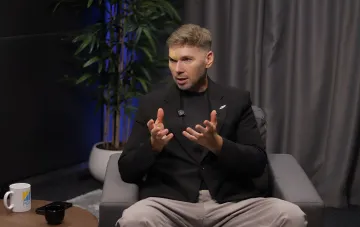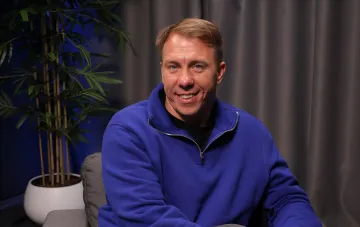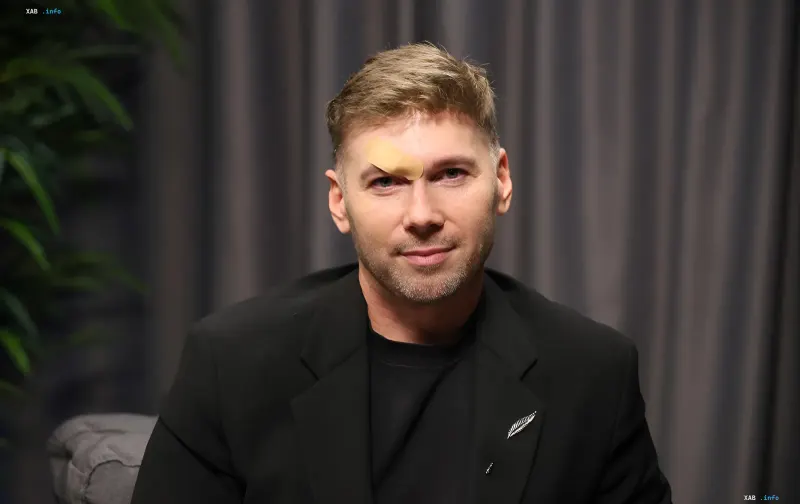
Ukrainian film producer, director, and actor Oleksiy Komarovskyi, in a long-form interview for Wave RBC-Ukraine, spoke candidly about his path into filmmaking, the international release of the film "Khreshchatyk 48/2," the economic realities of Ukrainian cinema during the war, and his personal battle with cancer. The conversation, recorded in a long dialogue format, covers both professional and deeply personal topics — from his first step onto the stage at the age of nine to the reassessment of life priorities after a skin cancer diagnosis.
From "The Blue Lagoon" in a Chernivtsi cinema to producer school at thirty
Komarovskyi recalls that his journey in film began at nine in Chernivtsi: he went to the Druzhba cinema (now the Mykolaychuk cinema) for a week straight to watch the film "The Blue Lagoon" and decided then that he wanted to be an actor. Exactly one month later, he was already performing in a children's troupe at a drama theater, and later in a regional academic theater troupe, working under a professional director. After a period spent in other fields, he returned to the industry at age thirty: he first completed producer school, then acting school. "I just realized you can't run away from yourself," he explains. Komarovskyi interprets the question of the necessity of a formal higher education flexibly: a diploma is not a criterion for him when selecting actors, as auditions and talent are what matter, although for those starting in the profession from a young age, he considers academic training mandatory.
"Khreshchatyk 48/2": 40 countries, Amazon, and 150 thousand foreign viewers
The main international achievement in Komarovskyi's career was the film "Khreshchatyk 48/2," which he says was released in 40 countries. The film also appeared on streaming platforms: it is available on Amazon in 19 countries and on Tubi in five. The total audience abroad exceeded 150,000 viewers. For Ukrainian cinema, which generally remains niche in the global market, Komarovskyi calls these figures a colossal success and proof that a high-quality product can break through national borders.
The war economy: the market is held up by fans and patrons
A separate section of the interview is devoted to financial realities. Komarovskyi states that most Ukrainian films do not break even in the current conditions. The market, by his estimate, is kept afloat by loyal fan viewers and private patrons, rather than mass theatrical releases or government funding at previous levels. This, he emphasizes, does not cancel the necessity of filming, but requires a reassessment of funding and distribution models.
"The kick": a diagnosis that doesn't stop you
Recently, Komarovskyi spoke publicly about his diagnosis — skin cancer. In the interview, he does not hide the gravity of the situation, but interprets it through the metaphor of a "kick" (pendel) — a term for a sharp life shift that forces a person to stop and re-evaluate values. According to him, this "kick" is not a reason to stop: he perceives the illness as a stimulus to continue active work, not as a sentence. Komarovskyi does not disclose details of the treatment or make predictions, limiting himself to the statement that the diagnosis became a personal milestone after which he looks at priorities differently.
Dramedy as a genre and the "cult film" yet to come
Speaking about creative plans, Komarovskyi admits that large-scale science fiction and intense action films are not yet a strong suit of the Ukrainian school — in his opinion, they require specialized technical training. His personal genre preference is dramedy, the "dramatic comedy of life": themes of relationships, love, parent-child conflicts, betrayal, and misunderstandings. "The content is the same, the form of presentation is different," he summarizes. At the same time, he does not hide his ambitions: he wants to play a cult role and shoot a cult film, calling it a "closed gestalt" that has not yet been realized. The full version of the conversation is published on the Wave RBC-Ukraine YouTube channel.