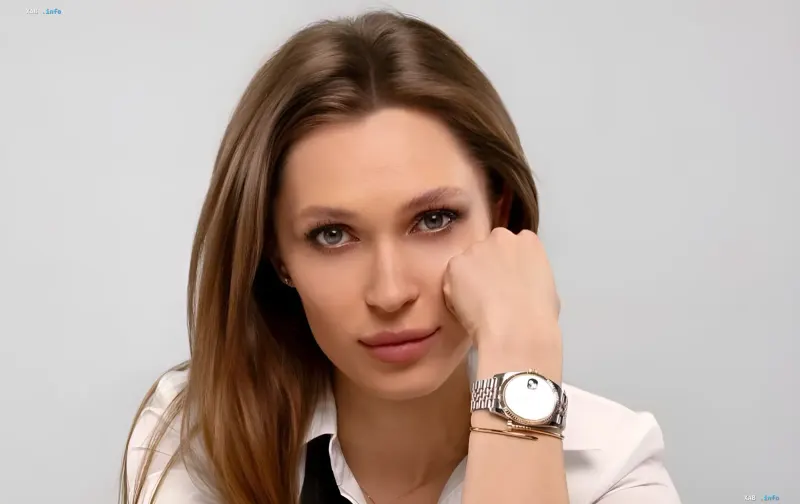
For Olena Svitlitska, acting was for a long time like an endless exam, one on which she had to prove over and over again her right to be in front of the camera. In an interview with Wave RBC.UA, the actress openly spoke about how her attitude toward the profession had changed: from painfully perceiving every rejection to making a conscious choice of projects in which her character leaves behind something meaningful. “Today I am much calmer. I no longer want to simply appear on screen for the sake of it. What matters to me is what the story is about, what my character will leave behind, and whether the role offers room for real creativity,” Svitlitska admits. In her words, acting has turned from a means of survival in the industry into a tool of self-exploration: “Now it is my way of exploring myself, people, and the world.”
From Announcer to Actress: How the Camera Opened Up the Profession
Svitlitska’s career was not a story of instant success. She studied at the film faculty of the Karpenko-Kary National University of Theatre, Cinema and Television, majoring in “announcer and television program host.” Yet it was precisely working in front of the camera that gradually led her to acting. “I can’t say there was one specific moment when I decided, ‘Okay, I’m going to be an actress.’ That realization came gradually — every time I found myself in front of the camera and felt that I could say something very personal and important through another person,” the actress recalls. Student projects, screen tests, episodic roles, and her first series began in 2011. Periods of uncertainty and rejections did not stop her: “I kept returning to the profession. I think that is when I realized this was truly my path.”
Two Roles That Changed Everything: From Valentyna Chystiakova to Her First Leading Role
Svitlitska names two projects that became turning points in her creative biography. The first is the series “Budynok ‘Slovo’. Neskinchenyi roman,” in which she played Valentyna Chystiakova, an actress and the wife of Les Kurbas. “It was not the largest role in terms of volume, but it was very important in content. Through it I touched the history of Ukrainian artists who were not only physically destroyed but also erased from our memory,” the actress explains. The second key stage was “Miy novyi bereh,” which became her first major leading role. “It became a test of my professional endurance and inner readiness to carry an entire story on my shoulders. This project finally helped me allow myself to believe that I am ready for big dramatic roles,” Svitlitska says.
War Changed the Heroes and the Language of Ukrainian Cinema
The actress emphasizes that war has deprived Ukrainian cinema of the ability to speak superficially. “Even if we are shooting a comedy or a love story, the experience of a country that fights for its existence every day is still present in it,” she notes. According to Svitlitska, the heroes themselves have changed: ordinary people facing extremely difficult choices are increasingly at the center of stories. The key themes have become memory, loss, home, responsibility, freedom, and the price of human life. At the same time, the actress insists: “I want Ukrainian cinema to tell not only about war. We have the right to show the world all of Ukraine — in love, funny, passionate, contradictory, and alive.”
A Vision of the Future: Industry, Not Just Talent
Speaking about the prospects of domestic cinema, Svitlitska formulates specific expectations. She wants to see Ukrainian cinema “strong, systemic, and competitive,” with regular releases of films in international distribution and the participation of Ukrainian actors in international projects without abandoning their language and identity. Among the priorities are the development of quality genre cinema (dramas, comedies, thrillers, historical films, projects for children), stable financing, transparent rules, and decent working conditions for film crews. “We already have talent and stories that the world needs to hear. Now we need an industry capable of turning this potential into a systematic result,” the actress concludes.
What to Watch: Svitlitska’s Recommendations
To close the interview, the actress named films that, in her opinion, everyone should see. First and foremost, she recommends Paradjanov’s “Tini zabutykh predkiv” — “to see how original, beautiful, and bold the Ukrainian cinematic language can be.” Also on her list is “Budynok ‘Slovo’. Neskinchenyi roman,” which became a personal creative turning point for her. These recommendations reflect the overall message of the interview: Ukrainian cinema has a deep historical and aesthetic potential that deserves both domestic and international recognition.