
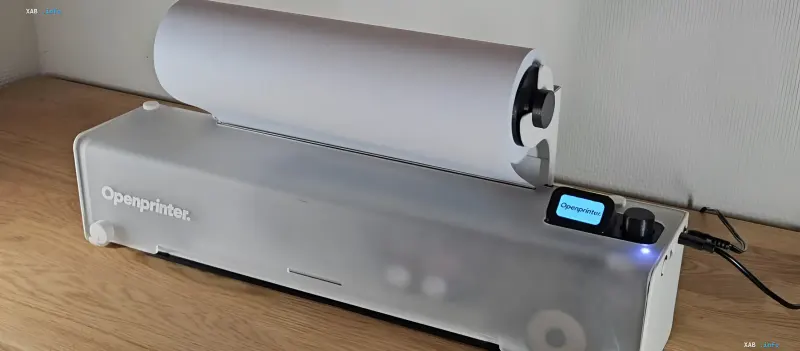
Parisian tech startup Open Tools has unveiled a working prototype of the Open Printer inkjet printer to the world. This device is positioned as the industry's response to forced subscriptions and digital locks. Developers promise open-source hardware, free from proprietary drivers and digital rights management (DRM) systems. The project has already gained recognition, winning two French industrial design awards, although the release date and final price remain uncertain.
Technical Architecture: Rejecting 'Black Boxes'
Development of the Open Printer has been underway for nine months, starting with the release of documentation on the Crowd Supply platform. The engineering team chose a modular approach, combining publicly available computing components with custom control boards. The core of the system is the rejection of closed proprietary solutions in favor of cross-platform compatibility.
The heart of the device is a Raspberry Pi Zero W single-board computer, which handles network protocols and works with the CUPS (Common UNIX Printing System) printing system. This solution allows the printer to work with Windows, macOS, Linux, iOS, and Android without the need to install specialized software from the manufacturer.
An STMicroelectronics STM32 microcontroller is used to control the positioning of the print head and manage the cartridge. The user interface is implemented via a 1.47-inch TFT LCD display and a mechanical encoder wheel (jog wheel) for menu navigation.
Specifications and Printing Capabilities
According to technical data, the Open Printer supports the following specifications:
- Print Resolution: 600 dpi in monochrome mode and 1200 dpi for full-color graphics.
- Interfaces: USB Type-C, USB Type-A, and a 24V DC power connector.
- Wireless Connectivity: Bluetooth 4.1 and Wi-Fi 802.11n (Wi-Fi 5 standard).
- Software: Open-source firmware and 3D printing files for the casing are available under the Creative Commons BY-NC-SA 4.0 license.
The license allows users to independently repair, upgrade, and assemble devices, but prohibits third parties from commercially producing analogues.
Economic Model and Consumables
One of the key features of the Open Printer is the concept of using widely available cartridges. The device is designed to be compatible with HP cartridges that have built-in print heads: the HP 63 model for North America, HP 302 for Europe, and HP 803 for Asia.
The design ensures an independent ink tank cycle. This means that the depletion of one component (for example, black ink) will not lead to a software lock of the entire device, which is a common practice among traditional manufacturers.
Risks of Dependence on HP
Despite the declared independence, industry analysts point out a significant infrastructural contradiction in the project. Using cartridges from the multinational corporation HP maintains a critical dependence of the startup on the production policy of a third-party issuer.
Hewlett-Packard is known for implementing strict protection systems, such as Instant Ink and Dynamic Security technology, which blocks non-original consumables. Although some programs have been discontinued under consumer pressure, risks remain. HP could change the geometry or firmware of future cartridge revisions, rendering them incompatible with the Open Printer.
Current Development Status
At the moment, Open Tools engineers are continuing to refine paper feed mechanisms, automatic nozzle cleaning algorithms, and Wi-Fi wireless protocols. From a legal standpoint, the use of original cartridge casings for integration into independent complexes is classified as fair use, provided there is no commercial copying of patented decoding microchips.


