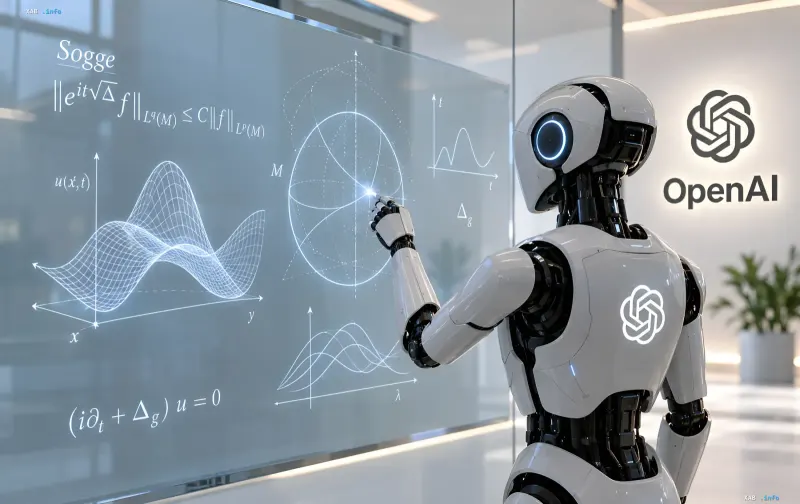
OpenAI has announced that its artificial intelligence system has generated mathematical proofs which, according to the company, could challenge a number of established concepts in mathematics and computer sciences. The central result is work on the local smoothing conjecture, a harmonic analysis problem formulated by mathematician Christopher Soggee back in 1991. According to the developers, OpenAI's models proved this conjecture for all spatial dimensions, and the final proof was generated on October 18, 2026, and formalized in the Lean interactive environment the very next day.
What is the Local Smoothing Conjecture
The conjecture describes the behavior of waves at the moment of their concentration and asserts that extreme focusing of a wave field cannot be sustained for a long time. Formally, it refers to estimating the norm of the evolution operator (in the notation provided in the company's materials, via the exponential operator with the square root of the Laplacian) in Lebesgue spaces on a manifold M. Prior to OpenAI's work, scientists had only approached the full result: in 2019, the smoothing conjecture was proven for two dimensions, and in 2025 the three-dimensional Kokuya conjecture was confirmed. The new proof, according to the developers, automatically closes two other well-known mathematical questions related to this topic.
How the AI Arrived at the Solution and Why It Matters
According to OpenAI's announcement, the company's neural network models derived the proof covering all spatial dimensions, thus generalizing previous particular cases. This is positioned as a breakthrough because the problem remained open for over thirty-five years and went beyond standard computational approaches. The company emphasizes that the result could revise a number of established views in both pure mathematics and related branches of computer sciences.
Formalization in Lean and Open Strategy
To ensure verifiability, OpenAI chose an open strategy: text and formalized proofs have been published in the open domain on GitHub. A key step was formalization in Lean, a specialized tool that allows a computer to check the logical correctness of mathematical arguments. According to the company, formalization was successfully completed on October 19, 2026, the day after the proof was generated. This means that an independent researcher can reproduce and verify each logical step using a computer rather than relying solely on a textual description.
Quantum Chromodynamics and Independent Verification
In addition to the mathematical result, the researchers reported proof of the existence of theories describing the behavior of matter at the level of the smallest particles, in particular quantum chromodynamics. Research in quantum physics, according to OpenAI, will be led by a separate external group of scientists who will prepare their own independent analytical report in the near future. Thus, part of the company's claims still remains at the stage of awaiting an external verification report.