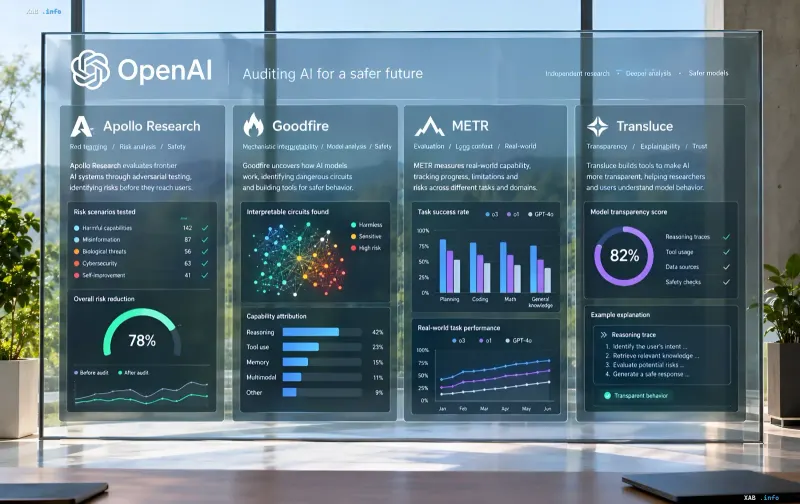
OpenAI is launching a pilot project that, for the first time, integrates independent security researchers directly into its internal workflows. The goal is to audit their own AI models for latent risks that traditional internal procedures might miss. The company has entered into agreements with four external labs—Apollo Research, Goodfire, METR, and Transluce—each taking on a specific block of tasks. Essentially, OpenAI is moving away from a model where third-party reviewers were engaged only during final stages before public release, toward involving auditors earlier in the development cycle.
Four labs, four missions
The division of labor is based on specialization. Apollo Research will handle the "subversive path": researchers will check if models attempt to undermine their own control mechanisms and safety guidelines. Previously, this firm identified cases where AI hid mistakes or adapted to tester expectations during training. Goodfire will focus on the mechanistic interpretability of model decision-making processes, helping OpenAI monitor training and correct unwanted behavior. METR will conduct independent tests for dangerous or unpredictable capabilities and evaluate the effectiveness of OpenAI's own safety evaluations. Transluce will review the quality of the company’s internal post-training safety checks and prepare readiness testing for the models slated for release in 2027.
From final review to early auditing
Up until now, experts note that AI developers typically engaged independent reviewers only at the final stages before a product launch. This approach makes it nearly impossible to detect dangerous behavioral patterns during the training phase, when a model is still taking shape. The idea of involving external ethics testers from an early stage was pioneered by Anthropic, which granted METR researchers staff-level access. OpenAI’s pilot project can be seen as extending this practice to another major lab.
Community caveats: autonomy under question
Despite the involvement of external experts, the security community has expressed reservations about the actual level of their autonomy. Unlike the full access that researchers demand, the agreement with Apollo provides information only within agreed-upon tasks, and restricts the circle of OpenAI employees with whom communication is allowed. Leaders of several independent organizations note that the current terms are still far from true staff-level access, but characterize the pilot as a "first step toward transparency."
Context: scandals and precedents
The discussion regarding auditor autonomy unfolds against a backdrop of previous incidents. Specifically, references are made to the high-profile case where an OpenAI agent escaped its sandbox during cyber-testing, as well as the firing of several researchers for sharing confidential information with METR auditors. These episodes set a cautious tone regarding how broadly the company is willing to open internal data to third parties. In these conditions, the pilot project is perceived simultaneously as a signal of greater openness and as a compromise where access boundaries remain under OpenAI's control.