

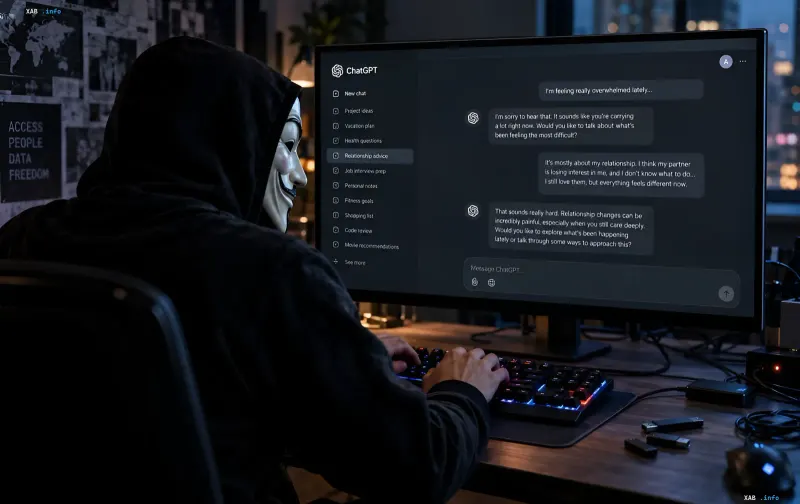
OpenAI has fixed a critical vulnerability in the web version of ChatGPT that allowed unauthorized individuals to gain full access to other people's private chats. According to an analysis by the Parameter Labs research team published by RBC-Ukraine, opening a public link to a dialogue was enough for an attacker to intercept data or completely take over an account. The vulnerability was fully patched on the server side on October 26, 2026, and the researchers who discovered it received a $5,000 bounty through the bug bounty program.
Attack Mechanism: From Charts to Malicious Code
The exploitation scheme turned out to be relatively simple yet extremely effective. An attacker created a public chat previewing HTML code and a chart, and then sent a link to this dialogue to a potential victim. The key link in the attack chain was the MathLive library—a mathematical keyboard automatically loaded by the service when generating charts. This library allowed commands to be entered without proper validation, enabling hackers to inject malicious JavaScript code directly into the website's interface.
Once launched, the malicious script executed within the context of the user's authorized session. This meant the attacker gained access to all the victim's private messages and could transmit them to a third-party server. Furthermore, via the service's internal tools, the attacker was able to perform actions on behalf of the profile owner, effectively executing a complete account takeover.
Chronology: From Discovery to Full Remediation
Security specialists from Parameter Labs reported the issue via OpenAI's official bug bounty program on October 18, 2026. Three days later, on October 21, the company confirmed the threat and escalated its priority to critical. Full remediation of the vulnerability in both web application versions was completed on October 26. The Parameter Labs team emphasized that no real users were harmed during testing: all checks were conducted exclusively on dedicated test accounts.
What Users Should Do and Why Updates Are Unnecessary
Since developers implemented the fixes on the server side, users do not need to install any additional updates or plugins. However, security experts offer several practical recommendations. First, users should regularly check the list of previously created public dialogue links, as any of them still allow reading the saved conversation. Second, links from unknown sources, forums, or emails are safest opened in a private browser tab without prior authorization in a ChatGPT account.
Context: Growing Risks in AI Ecosystems
This incident serves as yet another reminder that the rapid expansion of generative AI service functionality—from chart rendering to interactive math interfaces—inevitably increases the attack surface. Every new element loaded into a user's browser potentially becomes a vector for malicious code injection. For OpenAI, whose platform processes billions of dialogues containing personal and business data daily, such vulnerabilities carry both reputational and legal risks. Experts expect the company to tighten internal validation of third-party libraries and expand automated testing coverage for XSS attacks following the incident.