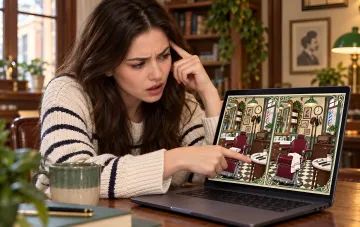
In a world saturated with visual information, the ability to quickly and accurately analyze the surroundings is becoming a rare skill. Our brain is evolutionarily tuned to perceive the world as a whole, instantly filling in missing details based on familiar patterns. It is precisely this feature, which helps us save energy, that becomes a trap in attention tasks. The Styler project from RBC-Ukraine has prepared a new optical puzzle that vividly demonstrates how easy it is to miss an object if it does not fit the general context, even when it is literally right before our eyes.
Perception psychology: why we don't see the obvious
The riddle proposed by Styler is based on the classic principle of human attention. The image depicts a cozy room: a bookshelf, candles, indoor plants, and an armchair with a blanket. This composition creates a powerful associative chain related to relaxation and reading. The brain, reading this "cozy" context, automatically marks most objects as "own" and "correct." As a result, the item that clearly falls out of this picture remains unnoticed. This is not a sign of inattentiveness, but a feature of cognitive processing: we trust the general picture rather than a detailed analysis of every pixel.
The "extra object" riddle: how to find the anomaly
The essence of the task is simple but deceptive. In a room decorated for an ad of a perfect evening with a book, there is one item that clearly ended up there by accident. It is not a book, not a candle, and not a plant. To find it, you must consciously switch your brain from "general perception" mode to "detailed check" mode. Those who are able to instantly read the whole room often see the anomaly immediately, as their brain notices the dissonance faster. For others, it takes time to review every element of the interior and find what disrupts the harmony.
Attention test: training cognitive abilities
Such puzzles are not just entertainment, but an effective tool for training attention. Styler offers readers not only to find one extra item but also to pass a more complex attention test where you need to find all the differences in the photo within a minute. Regularly performing such exercises helps develop the ability to notice details that may be critically important in daily life and professional activities. This ability to notice that "something is wrong" even before we realize the reason is a valuable skill.
About the Styler project and rules for using materials
The material was prepared by the Styler editorial team — an entertainment project from RBC-Ukraine (identifier in the Registry R40-05347), which focuses on lifestyle content: trends, stars, tips, and horoscopes. It is important to note that when using Styler materials, copyright must be respected. Photos belonging to Getty Images require written permission, while content marked with the Styler or RBC-Ukraine logo is available under the Creative Commons Attribution 4.0 International license. When reproducing materials, an active hyperlink to the source is mandatory.