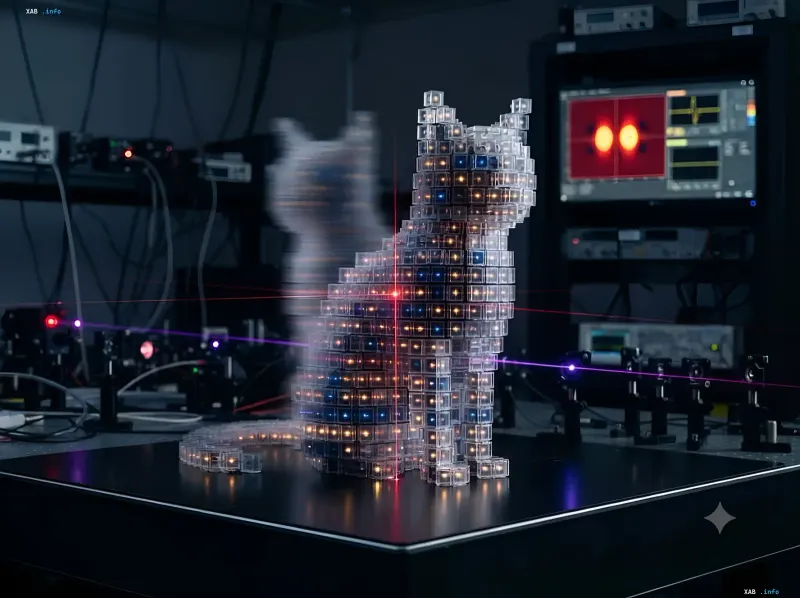
In the world of fundamental science, an event has occurred that may revolutionize our understanding of quantum engineering. Physicists from the University of Oxford have successfully conducted an experiment that was previously considered a purely theoretical concept. For the first time, scientists have managed to practically obtain arbitrary superpositions of irregular and "squeezed" states of a quantum harmonic oscillator.
Until now, such exotic combinations existed only in equations. Practical research was limited to creating familiar "Schrödinger's cat" states — a vivid illustration of quantum superposition where an object exists in two states simultaneously. The Oxford research group managed to go beyond these boundaries, opening a new chapter in quantum mechanics.
A Single Ion as the Basis of a Complex System
To achieve this breakthrough result, scientists used an ultra-precise setup. At the center of the experiment was a single strontium-88 ion placed in a Paul trap. In this system, the roles were distributed as follows: the internal electronic levels of the ion served as a qubit, while its mechanical vibrations acted as a quantum harmonic oscillator.
The key to success was entangling the ion's motion with its spin state. This was achieved thanks to nonlinear interactions of various orders that depended on the particle's spin. This technique allowed for controlling the quantum state with unprecedented accuracy.
Negative Probability as Proof
Specialists compiled a detailed map of states in phase space, recording a clear interference pattern within it. The most striking fact was the depths of this pattern extending into the negative region. In classical physics, the probability of an event cannot be negative — this contradicts common sense.
However, it is precisely this parameter that became the main proof that a true quantum superposition had formed before the researchers, rather than just a collection of ordinary probabilities. The appearance of negative values on the map is a "fingerprint" of the quantum nature of the system, unattainable in the classical world.
From Theory to Engineering
The universality of the developed methodology opens broad horizons for future research. The technology can be transferred to any systems with spin-oscillator coupling. Potential objects for applying the method include:
- superconducting circuits;
- atoms in optical resonators;
- nanoparticles in traps.
As a result, complex non-classical states are transforming from abstract mathematical exercises into real tools of quantum engineering. At present, specialists and theorists continue to work on the quantitative assessment of the "quantumness" of the created states to use them as effectively as possible in new technologies.