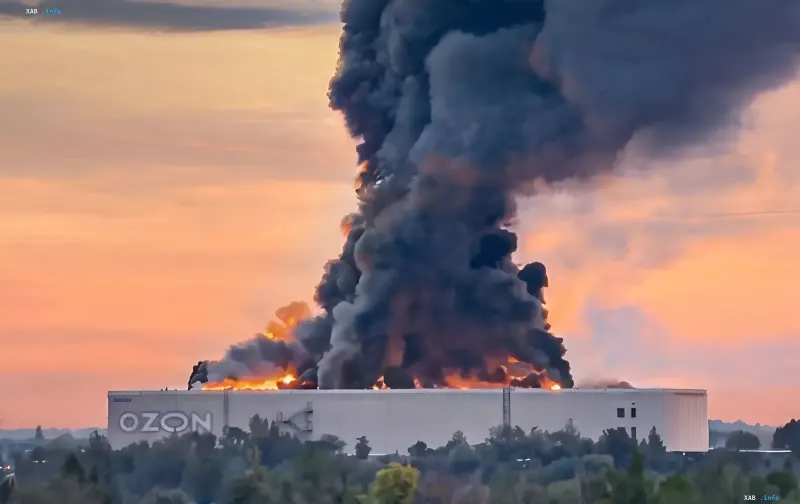
On Saturday, August 22, the Defense Forces of Ukraine officially announced a transition to systematic strikes against the logistics hubs of the Russian marketplace company OZON. This was reported by RBC-Ukraine, citing the Telegram channel of the Ministry of Defense of Ukraine. According to the ministry, the first attacks targeted facilities in the Samara region, where a "drone danger" mode was declared during the night of August 22, and a fire broke out at an OZON warehouse in Chapaevsk by morning.
Official Confirmation: OZON's Turn Has Come
The Ministry of Defense of Ukraine emphasized that the campaign against storage centers for dual-use goods is aimed at complicating the enemy's logistics and negatively impacting the Russian economy. The official statement declared that after the destruction of "15 of the largest Wildberries logistics hubs," it is now OZON's turn: "Our long-range sanctions are working — effectively and efficiently," the text reads. Thus, the ministry publicly confirmed for the first time that since August 22, Ukraine has been deliberately attacking the infrastructure of this specific marketplace, not just Wildberries.
Chronicle of the Night Attack in the Samara Region
According to available data, a "drone danger" mode was introduced in the Samara region of Russia during the night of August 22. By morning, it became known that drones had struck an OZON warehouse in Chapaevsk, causing a fire on the site — this event is captured in published footage, where a column of black smoke rises above the roof of a white logistics complex with the "OZON" logo against a sunset sky. The attack targeted one of the largest storage and distribution points for the marketplace in the region.
Role of Fire Point and FP-1 Drones
In the first half of the day on August 22, the Ukrainian company Fire Point confirmed that two targets in the Samara region — the Novokuibyshevsk Refinery and the OZON warehouse — were hit using FP-1 drones. This confirmation, independent of the Ministry of Defense, specifies the means and geography of the strike: it concerns a combination of a "logistics facility + oil refining infrastructure" within a single night operation, which aligns with the ministry's stated strategy of striking logistics and energy simultaneously.
Logistics as a Target: Strikes on Marketplaces
The shift from Wildberries to OZON demonstrates an expansion of the list of priority civilian-economic objects that Kyiv considers dual-use elements. According to the Ministry of Defense's logic, damaging distribution hubs disrupts supply chains, slows down goods turnover, and hits the revenue of the largest trading platforms, which should eventually translate into economic losses. The expert context discussed in specialized media indicates that such attacks can reshape the geography of the marketplaces' warehouse networks and increase logistics costs in the affected regions.
Contradictory Data
It is important to distinguish between officially confirmed facts and statements from one side. The specific fire at the OZON warehouse in Chapaevsk and the strike on the Novokuibyshevsk Refinery are confirmed by both the Ministry of Defense and the independent confirmation from Fire Point, while the "drone danger" mode in the Samara region was recorded by regional sources. However, the sweeping formulation regarding "15 of the largest Wildberries logistics hubs" and "systematic strikes on dual-use goods" is given exclusively in the statement of the Ukrainian ministry and is not supported in the provided materials by an independent count of damaged facilities. That is, the fact of the current attack on OZON is confirmed, whereas the overall statistics of the campaign and the classification of all hubs as "dual-use" objects remain within the scope of Kyiv's official position.