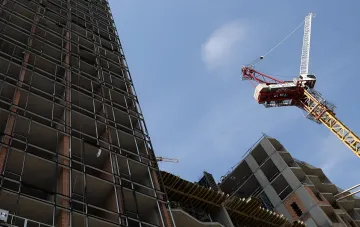
It would seem that market logic should be simple: war, regular shelling, and high interest rates should lead to a drop in real estate prices. However, the opposite is happening in Kyiv. Prices are not only not falling but continue to rise in certain segments. Real estate expert Oleg Derlyuk explains in an interview with RBC-Ukraine what is driving the market during the crisis and how the rules of the game have changed for buyers.
State Programs as Market Drivers
The key factor determining activity in the real estate market remains state support programs. As soon as the state begins financing, the market comes alive: the number of transactions grows, supply increases, but prices follow demand upwards. Conversely, pauses in financing, such as the current situation with the "єВідновлення" (e-Renovation) program in July, lead to cooling. It is expected that financing for housing certificates for destroyed homes will resume in September.
From May 1 to July 1, there was a surge in activity regarding housing vouchers — a support tool for certain categories of internally displaced persons (IDPs). The first 2,000 people have already realized their housing rights, and a new tranche of certificates is expected in August-September.
Currently, the main volume of transactions is formed by Cabinet of Ministers Resolutions No. 280 and No. 719, which allocate funds for purchasing housing for military personnel and their families. An interesting fact is that within these programs, demand is shifting to the secondary market. Housing "from hand to hand" is often cheaper and fits better within the budget limits established by the resolutions.
New Developments: The Factor of Trust and Reputation
The situation with new developments is more complex. After the history of "frozen construction" by "Kyivhorostroy," buyers have become extremely cautious. Today, the developer's reputation plays a decisive role. Companies that have managed to commission many objects and justified client trust continue to sell apartments successfully even during the war.
The Illusion of Price Growth in the Secondary Market
Why are prices not falling? The expert points to a psychological aspect. During periods of active state program financing, especially in the market for one- and two-room apartments, a frenzy arises. Owners, seeing demand, begin to unjustifiably inflate prices, creating an illusion of high value for their housing. Moreover, Kyiv remains attractive for resettlers from frontline and occupied territories, which supports demand.
Statistics from LUN (Low-Cost Urban Real Estate) confirm the reality of these prices: the average cost of a one-room apartment on the secondary market is about $70,000, and a two-room apartment is $105,000. These figures are verified by realtors who indicate the actual selling price, not the starting price of the listing.
Growth in the Cost of Square Meters and Renovations
The price dynamics at the construction stage are also impressive. If 5 years ago a square meter at the foundation stage cost $700–900, now in the same areas the price has risen to $1,200–1,300. This is a growth of at least $500 per square meter.
However, buyers are facing a new reality: for this money, they receive "bare walls," often only with rough plastering. A significant part of the budget goes to renovation. The cost of construction work has increased manifold: if before the war a basic renovation cost $300 per square meter, now this amount is just the starting point. A decent renovation with furniture is now estimated at $1,000 per square meter.
Problems with the "єОселя" Program
The affordable mortgage lending program "єОселя" (e-Settlement), despite loud PR, in practice faces serious bureaucratic barriers. The main problem is the strict limit on the price per square meter. Previously, buyers could pay the difference if the apartment price exceeded the program limit, but now this option has been canceled. It is becoming increasingly difficult to find a new development with a renovation that meets the requirements of "єОселя".
There are also restrictions on area standards. For example, until July 17, a mother with a 14-year-old child could only claim an apartment of up to 52.5 square meters, which did not meet the needs of a full family. The rules were adjusted, but banking nuances remain. Even with funds for a down payment, banks often refuse credit due to insufficient official income (for example, teachers with a salary of about 20,000 hryvnias). Hidden costs are added to this: insurance, commissions, and document processing.
Rental Prospects
The rental market showed seasonal behavior: demand dropped at the end of June and beginning of July, however, an increase in activity is expected in August due to the start of the academic year and an influx of students.