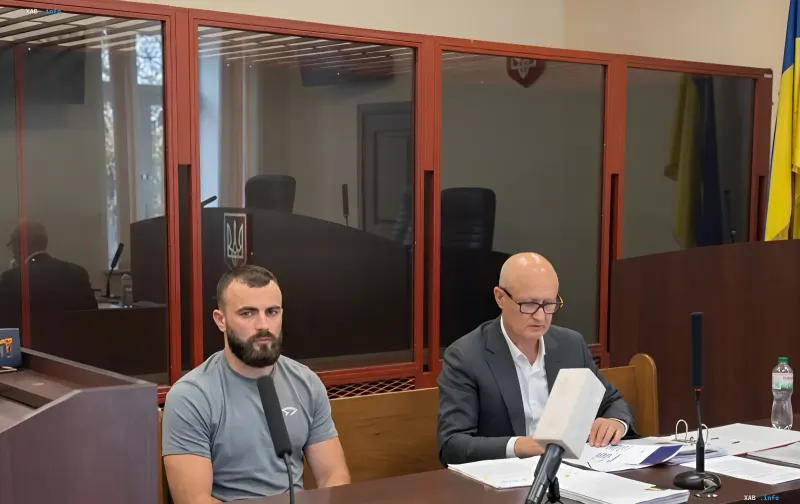
On 4 September 2026, the Pechersk District Court of Kyiv released Nazar Verkholu — an officer of the Security Service of Ukraine (SBU) who is a suspect in a criminal case linked to a gunfight between SBU operatives and servicemen of the Main Directorate of Intelligence (GUR) of the Ministry of Defence — from custody. The precautionary measure was set as a personal undertaking by the head of the SBU's counterintelligence department. As a result, Verkholu, who is charged with exceeding his official authority (Part 2, Article 365 of the Criminal Code of Ukraine), left the courtroom without being detained and without posting bail.
Closed hearing and the parties' positions
The hearing on the precautionary measure was held in a closed format: both the prosecutor and Verkholu's defence counsel asked the judge to close the session to the participants of the proceedings. The prosecutor insisted on detention with the possibility of posting bail in the amount of 1 million hryvnias. The defence, by contrast, demanded the application of the mildest precautionary measure. The court ultimately sided with the defence, choosing a personal undertaking by the head of the relevant SBU department — a formula that, in practice, means the suspect remains at liberty but is obliged to appear when summoned by the investigation and not to leave a defined administrative district.
Context: the shooting in Berezniahky
As a reminder, the incident that gave rise to the criminal case took place on the morning of 2 September 2026. Video footage of the aftermath of the shooting in the Berezniahky residential area, at a house on Yuri Shumsky Street, quickly spread across social media. Police urgently blocked traffic in the area, and law enforcement officers worked at the scene. According to law enforcement, three people were injured in the gunfight. The conflict erupted against the backdrop of the detention of Stepan Kaplunov, deputy commander of the Russian Volunteer Corps (RDK), who was taken into custody the day before the shooting.
The SBU's version and the Kaplunov case
The Security Service of Ukraine stated that the detained Kaplunov allegedly had contacts with the Russian Federal Security Service (FSB) and was preparing an assassination attempt. However, there is a significant inconsistency in the wording here: in one of the SBU's official statements the phrase used is "an assassination attempt on one of the leaders of the Russian opposition," whereas in another source citing the SBU's position the reference is to "a terrorist act against one of the leaders of the RDK." This difference in defining the alleged target of the attack may be of fundamental importance for the legal qualification of the case and for understanding the motives behind the conflict between the agencies.
Second suspect: GUR serviceman Serhiy Ivanov
In parallel with the Verkholu case, on 4 September the Pechersk Court set a precautionary measure for the second suspect — Serhiy Ivanov, a serviceman of the GUR of Ukraine's Ministry of Defence. He had been formally notified of suspicion on the same shooting case in the capital the day before, on 3 September. The details of the precautionary measure chosen for Ivanov were not disclosed at the time of publication. Thus, the court proceedings in the case of the gunfight between the two security agencies are entering an active phase, while public discussion of the key details remains limited due to the closed format of the hearings.
Contradictory data
The main discrepancy in the available information concerns the alleged target of Kaplunov's actions. The majority of reports citing the SBU state that he was preparing "an assassination attempt on one of the leaders of the Russian opposition." Meanwhile, the headline and text of a publication on from-ua.org, also citing the SBU's position, frame a different version: it "prevented a terrorist act against one of the leaders of the RDK." Neither version had been publicly refuted or clarified by the SBU at the time the material was prepared. In addition, the exact date of the hearing in the Verkholu case is not always consistently indicated in primary sources — some publications date the decision to 3 September, others to 4 September, which may be related to the length of the proceedings and the session's continuation to the following day.