
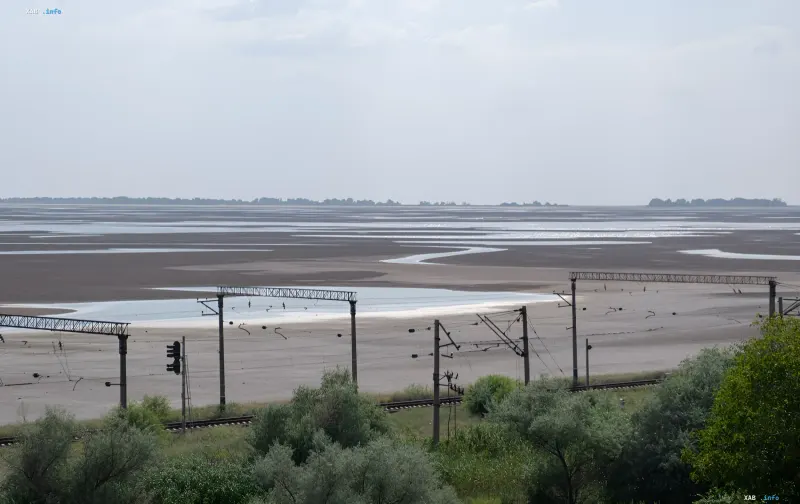
In the territory of the former Kakhovka Reservoir, which became the witness of an ecological catastrophe, an amazing phenomenon is taking place. During aerial reconnaissance, pilots of the 128th Separate Heavy Mechanized Brigade "Dike Pole" spotted a flock of wild pelicans. The birds returned to the shores where, after the dam explosion, Russian occupiers tried to destroy all living things.
Nature against terror
The brigade commented on the return of the feathered creatures as a symbol of nature's vitality. "They returned to the place where Russians tried to burn everything out. Wild pelicans are back on the shores of the former Kakhovka Reservoir! The occupiers blew up the dam, committing ecocide, but the Great Meadow is reviving! Nature is stronger than Russian terror," the military stated in their message.
New landscapes at the site of loss
The catastrophe occurred on June 6, 2023, when Russian occupiers blew up the Kakhovka HPP. This event led to the actual loss of the reservoir and radical changes in the region's ecosystem. Completely new landscapes have formed in place of the former expanse of water.
Most of the exposed bottom has rapidly grown with willows and poplars. In places where water currents once flowed, marshes overgrown with reeds and cattails have emerged. This process of transformation is confirmed by Academician of the National Academy of Sciences of Ukraine, Yakov Didukh. According to him, thanks to fertile silt, vegetation is recovering at an incredible speed, forming a poplar-willow forest.
Prospects and realities of restoration
The scientist notes that in the long term, these areas could turn into some of the largest floodplain forests in Europe, where forests, marshes, and open spaces will harmoniously combine. However, hopes for a complete return to the historical state of the Great Meadow are not justified.
"Restoration to the original state in nature is impossible. That primary Great Meadow will not exist — the relief there is already completely different, new soils have formed," Academician Didukh emphasizes.
Biodiversity of the new ecosystem
Despite the tragic beginning, the territory demonstrates a high capacity for self-restoration. Scientists are recording the appearance of migratory birds in the place of the former water area, including protected species such as the white-tailed eagle and the bittern. The plant world is also diverse: there are about 340 plant species on the territory, including rare and protected ones.
Particular interest is shown by unique biological processes: on the silt deposits, the indigenous species of lettuce, Lactuca tatarica, has begun to sprout, while on poorly formed soils, tamarisk is actively growing, forming a shrub layer. The return of pelicans is just one of the vivid testimonies that life has found a way to exist even in conditions created by human intervention.


