Last week, a wave of panic messages swept through social media and messengers once again: according to their authors, just thirty minutes of daily smartphone use in a dark room is enough to contract eye cancer or "incurable cataracts — a film over the eyes." The posts, backed by alarming wording and calls to "forward to all loved ones," garnered millions of views and caused a real hysteria among users. The XAB.info editorial team turned to the medical community's position to separate evidence-based medicine from viral folklore.
Ophthalmologists: no scientific evidence linking screens to cancer exists
Global ophthalmological associations and practicing physicians are unanimous: to date, not a single officially confirmed scientific study has been conducted that establishes a cause-and-effect relationship between smartphone screen light radiation and the development of cancer cells in eye tissues or the formation of cataracts. Experts emphasize that panic statements about an "incurable disease" after half an hour of screen viewing belong to the category of artificially fabricated messages created for viral spread and attention-grabbing. None of the major medical organizations — WHO, the American Academy of Ophthalmology, the European Society of Ophthalmology — publishes warnings of this kind.
What actually happens to the eyes during nighttime screen viewing
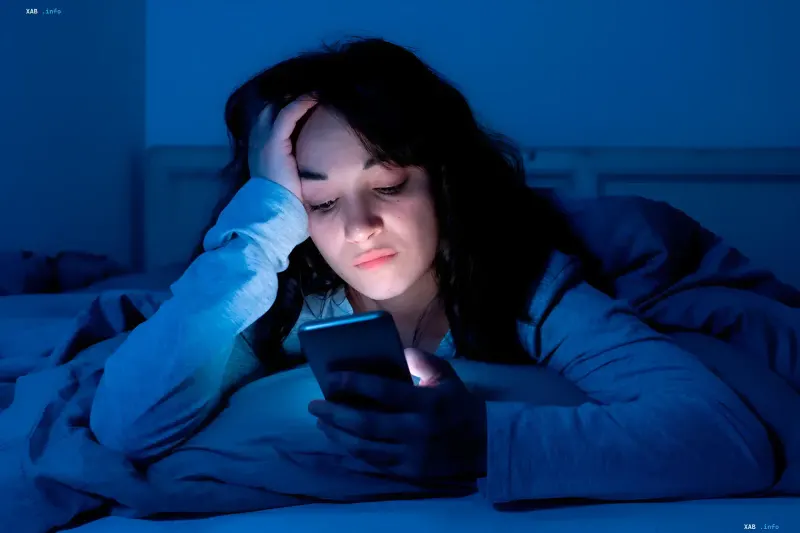
Although the threat of oncology is not confirmed, prolonged staring at a bright screen in a dark environment does cause noticeable damage to vision. First, when looking intently at a display, the blinking frequency drops several times, the cornea dries out, and redness, burning, and vasodilation occur — the so-called dry eye syndrome and "visual fatigue." Second, in the dark, the pupil reflexively dilates, and the blue light emanating from the screen affects the fundus with increased intensity. Over time, this leads to accommodation spasm and a gradual deterioration of visual acuity. Both mechanisms are described in clinical literature and do not require "harmful radiation" — normal display brightness against complete darkness is enough.
Blue light and hormonal imbalance: the hidden price of insomnia
The impact of the nighttime screen on the neuroendocrine system deserves special attention. The blue spectrum of light suppresses the production of melatonin, the hormone regulating the sleep-wake cycle. Regular use of gadgets in the dark shifts the chronotype, provokes chronic insomnia, daytime fatigue, and, consequently, a weakened immune system. For people who read their phones in bed before sleep, this effect accumulates and can turn into a persistent sleep disorder requiring correction.
Four rules recommended by doctors
Medics do not urge abandoning smartphones, but suggest a number of simple measures to minimize the strain on the eyes and nervous system. First, lighting balance: use the phone not in an absolute dark room, but at least with a nightlight or dim light turned on. Second, activate the built-in "Night Light" feature, which reduces the share of the blue spectrum, and lower screen brightness to a minimum. Third, put gadgets aside 30–60 minutes before sleep to give melatonin a chance to recover. Fourth, take breaks using the "20-20-20" rule: every 20 minutes, look at an object 20 feet (about 6 meters) away from your eyes for 20 seconds. Following these recommendations helps preserve vision and sleep quality without radical restrictions.
Thus, messages circulating in messengers about "incurable eye cancer" after thirty minutes of phone use in the dark are untrue and backed by no scientific research. However, the habit of using gadgets in complete darkness indeed carries real, though not catastrophic, risks for vision and general well-being. The answer to the question "is it harmful?" lies in the realm of evidence-based medicine: moderation, proper lighting, and sleep hygiene remain the best "medicines" that require no prescription.