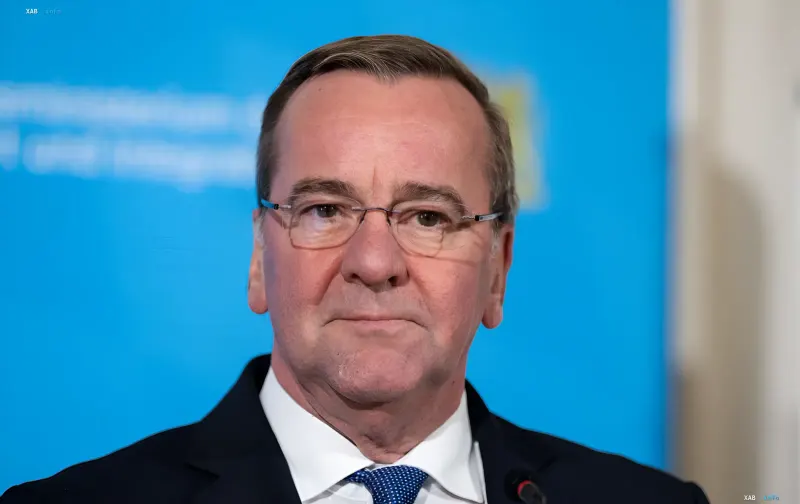
German Defense Minister Boris Pistorius has made a sharp statement urging European capitals not to reject Russian President Vladimir Putin's proposal to hold negotiations in Moscow. According to the head of the German defense department, refusing such an invitation would be 'absolutely the wrong signal,' and Europe itself is obliged to talk to Moscow if it can lead to concrete results. Pistorius's statement, reported by Spiegel and cross-checked by RBC-Ukraine, came amid mounting pressure on European diplomacy from several sides — from the Kremlin to Washington.
'Only those who talk can achieve results'
At the center of Pistorius's argument lies a pragmatic thesis: the diplomatic channel must not be closed on principle. 'We must talk. Only those who talk can ultimately achieve results,' the minister emphasized. He explicitly pointed out that declining the invitation to Moscow would be a mistake, as it would deprive the European side of the opportunity to influence the course of events and articulate its demands directly. Pistorius added that if Putin 'is now sending the first signals and inviting Europeans to Moscow, then this should be welcomed from all sides' — meaning, by his logic, Moscow itself is opening a window for dialogue that Europe must seize.
The invitation is not an end in itself: ceasefire is key
At the same time, the German minister stipulated that the format and location of the meeting are not of decisive importance. 'What matters in this process is not the invitation, but the concrete results of the negotiations, in particular a ceasefire in Ukraine,' Pistorius stated. Thus, Berlin, by its own account, is ready to discuss the conditions for stopping hostilities with Moscow, but does not intend to accept symbolic gestures as the outcome of the diplomatic cycle. Pistorius emphasized that a ceasefire must become the minimum measurable result of any round of contacts.
Warning against 'diplomatic decoration'
The German Defense Minister placed special emphasis on the risk of negotiations turning into a protracted process with no real consequences. He warned against a scenario in which diplomatic consultations would be used solely as decoration while Russian attacks on Ukrainian territory continue and people die. 'To figure this out, we must talk to each other,' Pistorius added, pointing to the need for direct dialogue to clarify positions. This warning effectively sets a time and content horizon: negotiations are permissible only on the condition that they do not become a cover for the continuation of hostilities.
Context: from Putin's initiative to Estonia's reaction
The initiative for negotiations in Moscow was previously voiced by Vladimir Putin himself, who stated that Russia had offered European representatives to come to the Russian capital to clarify their position on Ukraine and shape the post-war security architecture on the continent. In parallel, US President Donald Trump also urged Europeans to communicate directly with Putin, increasing pressure on European diplomacy in favor of contacts. Against this backdrop, Estonia, by contrast, gave a harsh response to Putin's proposal, highlighting the split within the European community on whether it is permissible to accept the Moscow negotiating format. Pistorius's position, therefore, occupies an intermediate stance: Berlin does not rule out dialogue, but sets strict conditions regarding content and results.