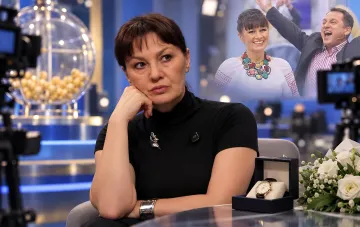
Artem Pivovarov allowed himself an ironic remark during his concert performance in Vinnytsia, alluding to Nastya Kamenskykh's resonant statement about the Ukrainian language and health problems. The musician's joke, delivered in the middle of performing a song he had released together with the singer, drew laughter in the hall and became a topic for active discussion on social media. This is reported by the entertainment project Styler (RBC-Ukraine), citing a video published on the TikTok account "Pivovarov.portal.fan".
Concert in Vinnytsia and the song "Tam u topoli"
The musician came to Vinnytsia for a solo concert. While performing the track "Tam u topoli," which Pivovarov released together with Nastya Kamenskykh in 2022, the artist urged the audience to sing louder. It was at that moment that he recalled the singer's recent story, linking it to the themes of health and language. "Well, Vinnytsia! Just don't tell me you have a cyst!" — Pivovarov joked, addressing the audience. Judging by the hall's reaction, the audience took the joke positively: laughter broke out in the hall, and under the TikTok video fans left numerous approving comments.
Context: Kamenskykh's statement in an interview with Gordeeva
The reason for Pivovarov's joke was Nastya Kamenskykh's resonant statement made in an interview with the Russian journalist Ekaterina Gordeeva. The singer talked about her experience of switching to the Ukrainian language and claimed that after about six months of communicating exclusively in Ukrainian, she lost her voice and was allegedly found to have a cyst. Kamenskykh also said that a psychologist advised her to return to Russian, since, in her words, her body "does not accept" Ukrainian. "I switched to the Ukrainian language and spoke exclusively in Ukrainian for six months. And, you know, I developed a cyst and lost my voice," the artist said in the interview.
Public reaction and the duality of the singer's position
At the same time, in the same interview Kamenskykh called the Ukrainian language beautiful and stated that, in her opinion, Ukraine should speak Ukrainian. She also emphasized that she wants to decide for herself in which language to communicate and sing. It is precisely this duality — acknowledging the value of the Ukrainian language while simultaneously linking it to health problems and the advice to "return to Russian" — that triggered a wave of sarcastic reactions on Ukrainian social media. The singer's statement became one of the most discussed in the Ukrainian media space during the preceding period, and Pivovarov's joke at the concert in Vinnytsia was, in essence, a public response from the artistic community to this discussion.
Contradictory data
The provided sources contain no direct factual contradictions in dates or figures: the concert took place, the joke was made, and the video was published. However, it is worth noting that Kamenskykh's story itself contains an internal contradiction pointed out by observers: the singer simultaneously claims that the Ukrainian language is "harmful" to her health and that a psychologist recommended she return to Russian, while also stating that Ukraine should speak Ukrainian and that she herself wants to decide in which language to sing. No medical confirmation of the "cyst" diagnosis, no comment from the psychologist, and no independent verification of the chronology of events (exactly six months in Ukrainian) are provided in the materials. Thus, Kamenskykh's statement remains her subjective account, and Pivovarov's joke is a public reaction to that account, not to a confirmed medical fact.
Audience reaction and the significance of the episode
Pivovarov's joke at the concert in Vinnytsia became an illustration of how public statements by artists about language and health quickly turn into memes and reasons for irony in the concert environment. The hall's reaction and the wave of approving comments under the TikTok video indicate that a significant part of the audience took the remark as appropriate and timely. The episode also shows that the topic raised in Kamenskykh's interview continues to remain relevant in the Ukrainian media space and is not limited to the framework of a single interview, but spills over into live concert communication and discussion on social media.