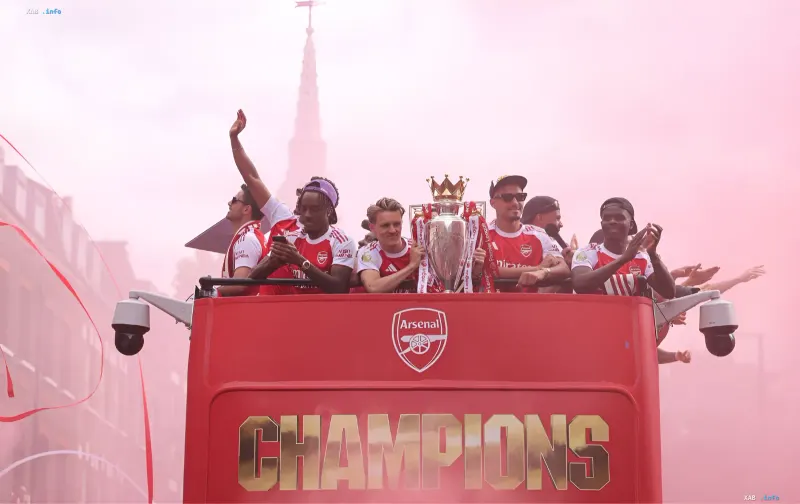
The English Premier League returns: on Friday, August 21, 2026, at 22:00, the new season will open with a match between Arsenal and Coventry. From the start, it feels like we are facing one of the most unpredictable tournaments in recent years. The structure of English football, which seemed almost unchanging for years, is undergoing a profound restructuring: the main coaches of several top clubs have left, and with them, the usual hierarchy. The only team that appears to enter the season with a clear understanding of its goal is Mikel Arteta's Arsenal.
Arsenal: From Three Second Places to the Championship and Beyond
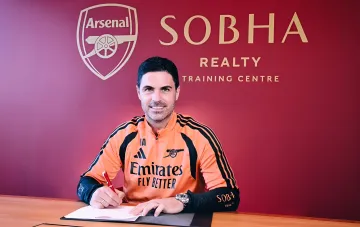
The Londoners finally won the championship after three consecutive second places, scoring 85 points and finishing the previous season with a goal difference of +44. However, the Premier League victory was not seen as a full stop within the club: the management and the head coach clearly "did not agree." In the summer, the squad was strengthened by Bruno Guimarães from Newcastle, Christos Tzolis from Club Brugge, and Piero Incapie from Bayer Leverkusen, who spent the previous season on loan in London. The team has become deeper, and Arteta now has the opportunity to vary the lineup more widely. The main advantage of the "Gunners" is stability: the team has been working with the same coach for over six years, key players are at their peak, and the game structure was built over the years. Now, Arteta faces a more complex task — to prove that the title was not the culmination of a separate cycle.
The End of the Guardiola Era at Manchester City
For more than a decade, City has been associated with one coach. Guardiola won six championship titles during his tenure, and more than half of all major trophies in the club's history were won under his leadership. Now on the sidelines is Italian Enzo Maresca, a student of Pep, who performed well at Chelsea. But the first attempt was a failure: in the FA Community Shield match, City lost to Arsenal 0-3, looked uncertain, and did not demonstrate their usual control. Moreover, the Italian has already lost several key players: Rodri moved to Barcelona, Bernardo Silva to Real Madrid, the team was left by John Stones, Nathan Aké, and Tijjani Reijnders, and the defensive structure has undergone serious changes.
The "Citizens'" Resources and Changes Among Competitors
It would be wrong to say that Maresca is working on ruins: the squad still includes Erling Haaland, Phil Foden, Ryan Sercu, Jeremy Doku, Antoine Semenyo, Marc Guehi, Nico O'Reilly, and Abdukodir Khusanov — a blend of experience, youth, and unquestionable talent. There is only a "small detail" left — to replace Guardiola in the post, and Arne Slot and the legion of successors to Sir Alex Ferguson will happily tell Maresca about this. Changes have affected others as well: Liverpool said goodbye to Arne Slot after a failed season and entrusted the team to Andoni Iraola, Chelsea hired Xabi Alonso, Manchester United continues its experiment with Michael Carrick, Newcastle let go of Eddie Howe and several key players, and Tottenham, after two seasons in 17th place, is trying to start from scratch.
Injury Risks vs Squad Depth
The only problem for the "Gunners" could be injuries: Bukayo Saka had problems with his Achilles tendon, Declan Rice was undergoing treatment for physical problems during the World Cup in the USA, and William Saliba suffered a back injury and will likely miss the start of the season. It is most difficult to find replacements for such key players. However, last season the "red-and-whites" survived the epidemic of injuries worthily, and now the depth of their squad has only improved. Thus, the intrigue of the new Premier League season revolves around the confrontation between the stable champion and the restructuring City against the backdrop of general instability among the other giants.