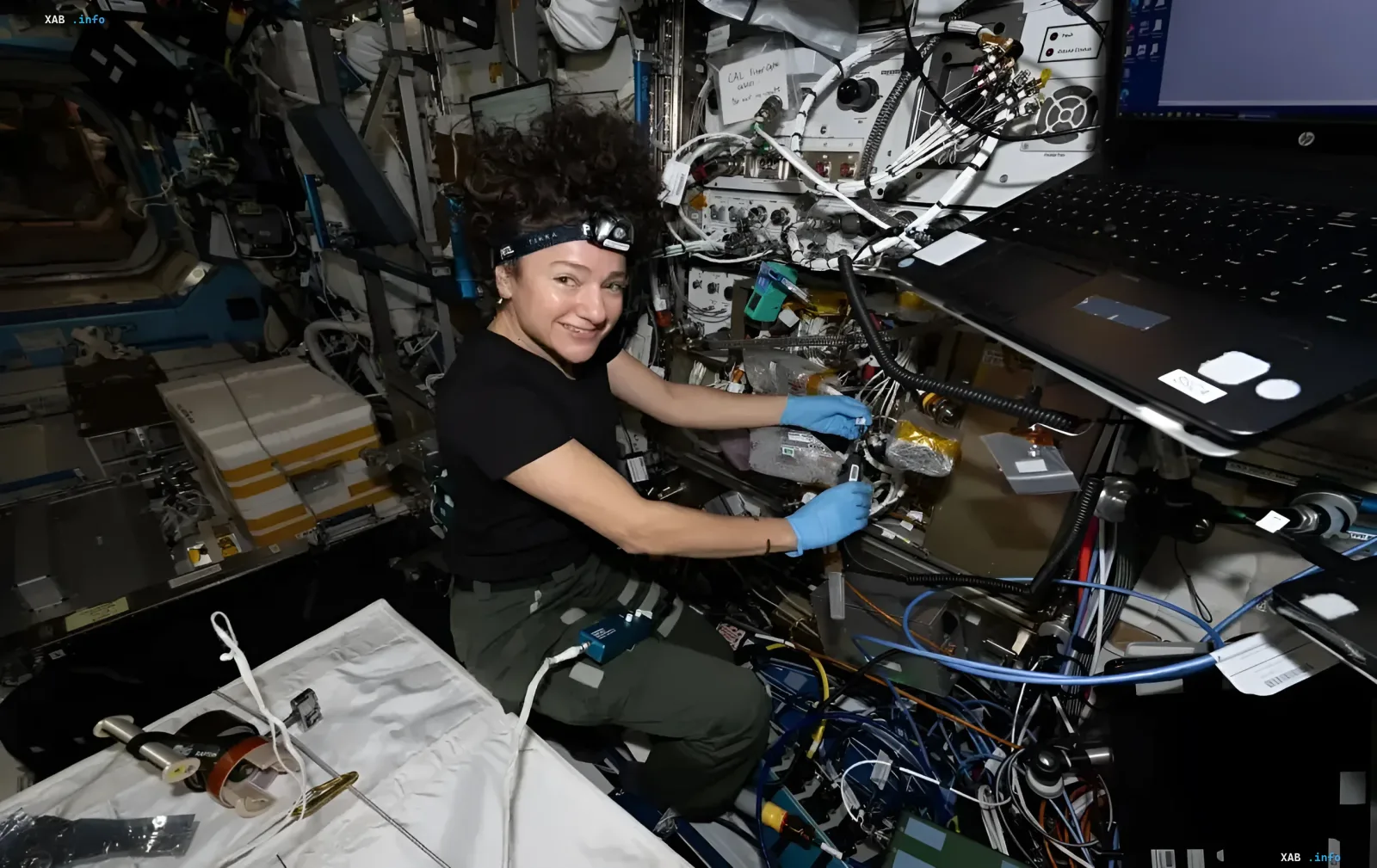
Aboard the International Space Station (ISS), an upgraded version of the Cold Atom Lab (CAL) has been successfully launched. This event opens a new chapter in the study of matter, providing scientists with a unique opportunity to conduct experiments that are technically impossible to replicate under Earth conditions.
The Fifth State of Matter in Microgravity
The laboratory's main task is to cool atoms of chemical elements to extremely low temperatures, dropping below -237 °C. Under such conditions, particles almost completely lose their kinetic energy of motion and merge into a single structure known as a Bose-Einstein condensate (BEC).
This physics phenomenon is called the fifth state of matter, following solids, liquids, gases, and plasma. In the condensate state, large clouds of atoms begin to behave like one giant quantum wave, obeying the laws of quantum mechanics.
Technology for Creating a Quantum Cloud
The process of launching the experiment represents a complex chain of actions requiring the highest precision:
- Gas Creation: special metal strips of rubidium or potassium are heated to temperatures around 400 °C, forming a dense gas inside a vacuum chamber.
- Laser Cooling: streams of lasers at a specific frequency act on the gas cloud, slowing down the movement of atoms and radically lowering their temperature.
- Magnetic Trap: atoms caught in a magnetic field undergo final cooling stages until the cloud freezes almost into complete stillness.
The key advantage of the orbital location is the absence of gravity. On Earth, the force of gravity quickly destroys the stability of fragile quantum clouds, whereas in space, scientists can observe the behavior of matter waves for much longer. This allows for ultra-precise measurements of time, gravitational fluctuations, and spatial motion.
Fourth Upgrade and "Quantum Revolution 2.0"
The current update of the scientific module is already the fourth stage of system modernization since its launch into orbit in 2018. The new equipment was delivered to the ISS by a commercial cargo mission.
Engineers made significant changes to the design:
- The magnetic trap has been completely redesigned, allowing researchers to change the shape of quantum gas clouds.
- Improved metal sources have been installed to generate more stable gas environments.
Currently, five international research groups are using the laboratory's capabilities. The upgraded complex will become a testing ground for next-generation technologies — the so-called "Quantum Revolution 2.0," which involves direct manipulation of large quantum states.
All processes of the Cold Atom Lab are managed remotely by specialists at NASA's Jet Propulsion Laboratory (JPL) in California, demonstrating a high level of automation and control over the most complex physical processes in orbit.


