On August 14, 2026, the Alibaba Cloud team released the new generation of models to the public — Qwen 3.8, including the flagship Qwen 3.8 27B weights under the open Apache 2.0 license. Following the March and May announcements of Qwen 3.5 and 3.7, the community expected a qualitative leap in multimodal data processing and reasoning (Chain-of-Thought). We conducted independent stress testing in live production conditions — over 240 generations — on a server with an NVIDIA GeForce RTX 3090 graphics card (24 GB VRAM), an AMD Ryzen 9 5900X processor, and 128 GB RAM running ComfyUI with the llama-mtmd-cli engine. Three models participated in the comparison: Qwen 3.5 27B, Qwen 3.8 27B, and the compact Qwen 3.8 9B, each tested in two modes: with hidden thinking enabled («Think») and disabled («NoThink»).
The results presented several unexpected surprises, the main one being the behavior of the built-in reasoning block.
1. The Paradox of Thinking: Why Qwen 3.8 is Faster in «Think» Mode
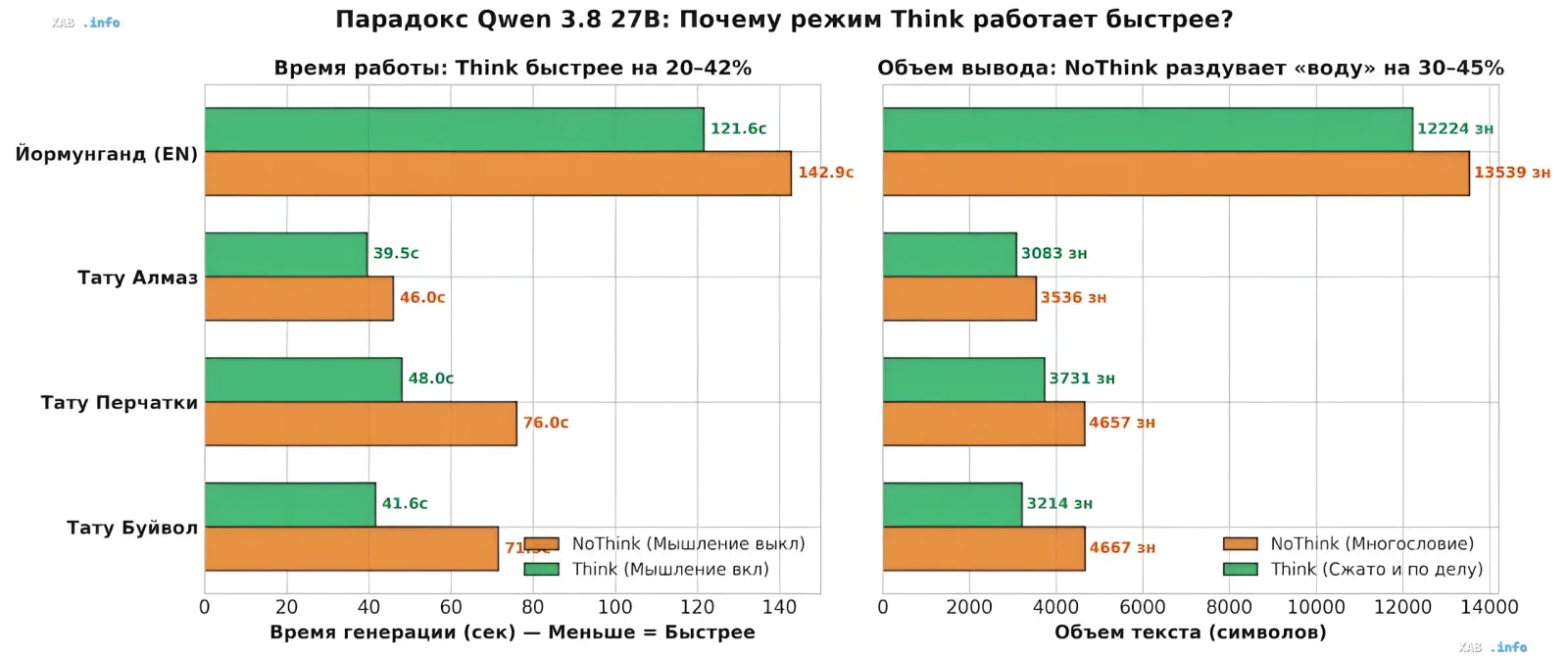
In theory, the generation of internal thought chain tokens (think tag) should slow down the task. However, on image analysis (Vision) and creative generation tasks, Qwen 3.8 27B in Think mode performed 20–42% faster than in NoThink. Analysis of the «Bison» tattoo (Vision): NoThink — 71.5 sec (4,667 characters / 607 words), Think — 41.6 sec (3,214 characters / 390 words), a 1.7x speedup. Analysis of «Boxing Gloves»: NoThink — 76.0 sec (4,657 characters), Think — 48.0 sec (3,731 characters), a 37% speedup. Translation of the «Jörmungandr» long-read into English: NoThink — 142.9 sec, Think — 121.6 sec.
The secret to the paradox lies in the architecture: Qwen 3.8 is natively optimized for CoT. When thinking is active, the model plans the logical structure of the response in 3–4 seconds and immediately generates precise, concise text without repetition. When the mode is forcibly disabled, the neural network «wanders» in its output, inflating the volume with synonyms and «fluff» by 30–45%. Since the output speed in tokens/sec is identical, the excessive text volume leads to delays on the stopwatch.
2. The Physics of Volumes: Generation Speed and RTX 3090 Memory Limits
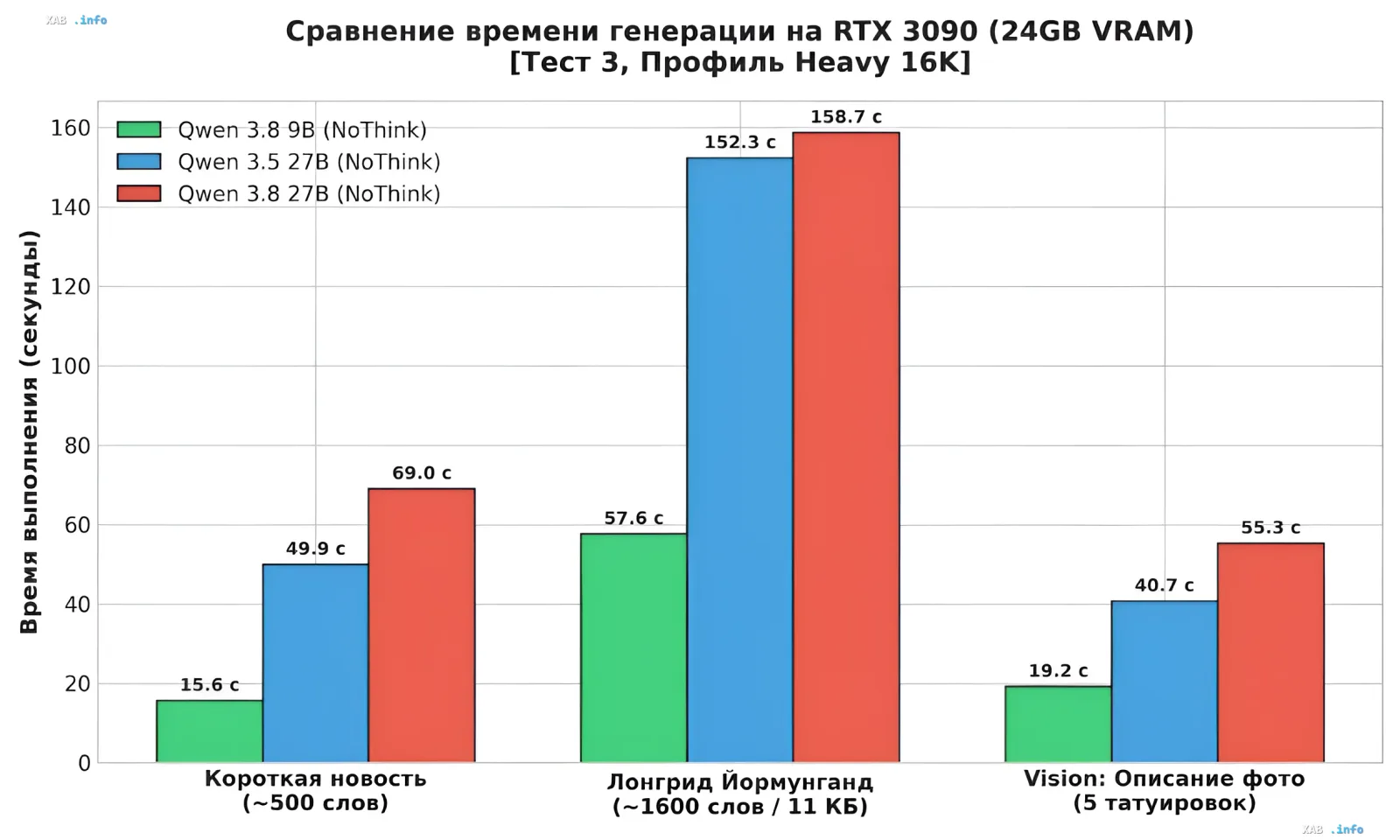
Testing on the Heavy 16K profile (ctx_size: 16384, max_tokens: 4096) showed a clear division based on VRAM throughput. Short news item (~500 words / 4k chars): Qwen 3.8 9B (NoThink) — 15.6 s (214 chars/s), Qwen 3.5 27B (NoThink) — 49.9 s (87 chars/s), Qwen 3.8 27B (NoThink) — 69.0 s (67 chars/s), Qwen 3.8 27B (Think) — 74.8 s (60 chars/s). 11 KB Long-read (~1600 words / 14k chars): 57.6 s / 152.3 s / 158.7 s / 151.6 s respectively. Vision analysis of a single tattoo photo: 19.2 s / 40.7 s / 55.3 s / 45.2 s.
The 9B model (~6 GB in VRAM) operates at a speed of ~28 tokens/sec (~220–250 chars/sec): even a 15,000-character long-read is translated in less than a minute. The 27B models (~17 GB in VRAM) hit the GPU memory throughput limit — stable ~9–10 tokens/sec (~75–88 chars/sec), and a long article physically takes about 2.5 minutes.
3. Language Profile: Who «Slips Up» on Translations
In Ukrainian, Qwen 3.8 9B is unsuitable for production: it allows gross Russisms and agreement errors («Ночна атака... попадань уривків» instead of «Нічна атака... влучання уламків», «Міровий змія» instead of «Світовий змій»). Qwen 3.5 27B and 3.8 27B (Think) are the standard: impeccable grammar, living literary language, and precise terminology («ураження енергетичної інфраструктури», «ДСНС»). In German, the 9B model confuses genders («der Tattoo» instead of «das Tattoo») and declensions, whereas the 27B models perfectly construct compound words («Lebensmitteltransporter», «Jörmungandr-Tätowierung») and observe verb governance. In English, all models deliver a C1–C2 level, with Qwen 3.8's vocabulary distinguished by heightened academicism.
4. Production Calculation: How to Fit 400 Articles and 1,200 Translations Per Day on 1 GPU
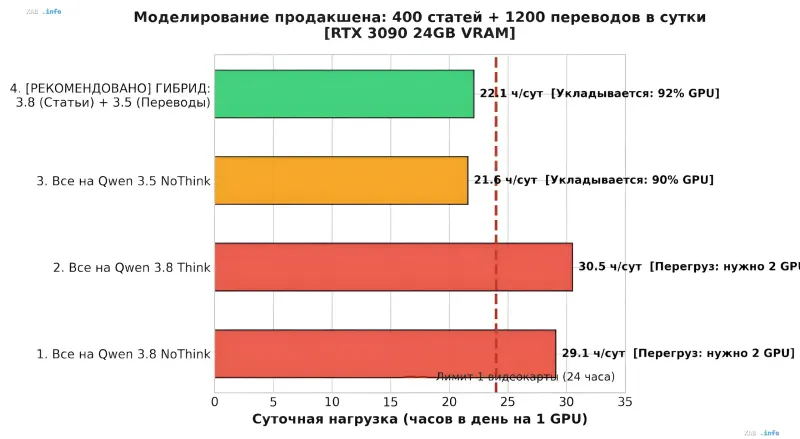
Consider a content portal pipeline: 400 unique articles per day and their translation into 3 languages (1,200 translations). The daily time fund of one RTX 3090 is 24 hours (86,400 seconds). All on Qwen 3.8 27B (NoThink): 400 × 55 s + 1,200 × 69 s = 29.1 hours (121% load) — the server cannot cope. All on Qwen 3.8 27B (Think): 400 × 50 s + 1,200 × 75 s = 30.5 hours (127%) — overload. All on Qwen 3.5 27B (NoThink): 400 × 45 s + 1,200 × 49.9 s = 21.6 hours (90%) — it fits, but the quality of originals deteriorates (loss of links and formatting).
The optimal hybrid — writing on Qwen 3.8 (Think) + translations on Qwen 3.5 (NoThink): generation of 400 articles on 3.8 — ~5.5 hours, 1,200 translations on 3.5 — ~16.6 hours, total 22.1 hours (92% power of one GPU). This provides maximum article quality and a stable stream of translations on a single server without queues.
5. Practical Conclusions and Implementation
Tests proved: Qwen 3.8 is a powerful tool for generating deep analytical content and working with visual images (Vision). But blindly translating all tasks to a single model leads either to an overspend of server power or a drop in quality on non-primary languages. Competent pipeline design (separating generation and localization) allows you to squeeze the maximum out of a single consumer-grade GPU class RTX 3090 / RTX 4090 and save thousands of dollars on cloud APIs. If your project requires setting up autonomous content pipelines, deploying local LLMs on rented GPU servers, optimizing ComfyUI/Python queues, or building turnkey multilingual news networks — check out our solutions and integration formats on the Services and Development page. We help businesses implement modern neural network technologies with minimal cost and guaranteed fault tolerance.