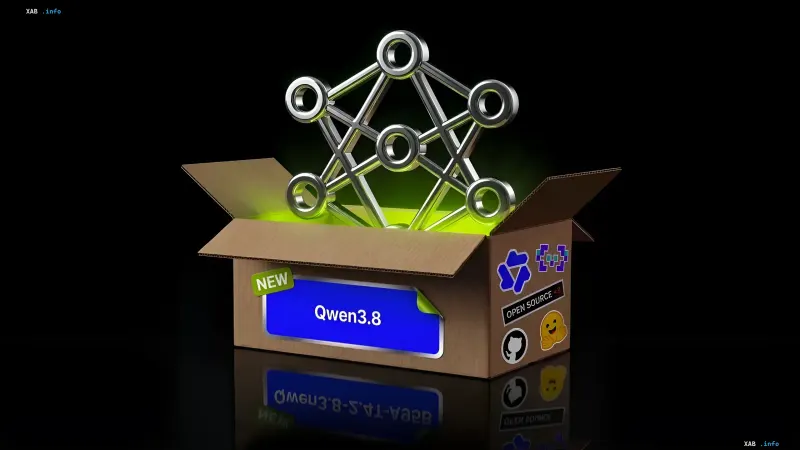
The modern artificial intelligence market continues to evolve rapidly, blurring the lines between heavy cloud systems and solutions for local deployment. A striking confirmation of this was a recent experiment with the Qwen3.8-27B model, which demonstrated unexpectedly high results in specialized programming benchmarks. Notably, this success was achieved on a heavily quantized 4-bit version, opening entirely new prospects for developers and enthusiasts who want to run powerful language models directly on their own hardware without sending confidential code to remote servers.
The Experiment and Initial Successes
According to published DeepSWE test data, the local Qwen3.8-27B model managed to pass 98% of checks on a specific code review task, scoring a flawless 12 out of 12 points. For comparison, advanced cloud systems score an average of about 96.6% on this exact subset of tests. This breakthrough sparked intense discussion in the professional community, as it concerns an open-source model running in an optimized and heavily quantized format rather than a closed industrial giant with colossal computing resources.
Technical Specifications and Local Deployment
In addition to impressive coding results, a key advantage of Qwen3.8-27B remains its accessibility for local infrastructure. Thanks to 4-bit quantization, the model requires about 13 to 18 GB of VRAM, allowing it to run on consumer graphics cards—such as popular 16 GB VRAM setups with proper configuration, or powerful consumer flagships like the RTX 4090 with 24 GB of memory. On the latter configuration, generation speeds reach an impressive 115 tokens per second, making interaction with artificial intelligence nearly instantaneous and comfortable for everyday programming tasks.
Contradictory Data
Nevertheless, experts urge maintaining a healthy dose of skepticism and not rushing to write off cloud flagship models. The author of the experiment himself emphasizes that the success was recorded during only a single specific run on a narrow task. The full DeepSWE benchmark includes 113 diverse tests, within which the best cloud systems handle an average of 70–74% of tasks, passing a specific check without a single error only about two times out of three. Furthermore, in deeper testing involving 43 hidden checks, the model passed 40, but the final binary result was zero because the task was not fully solved. Thus, the current achievements of Qwen3.8-27B demonstrate the colossal potential of open local neural networks, but do not yet mean complete technical parity with advanced cloud ecosystems in all usage scenarios.