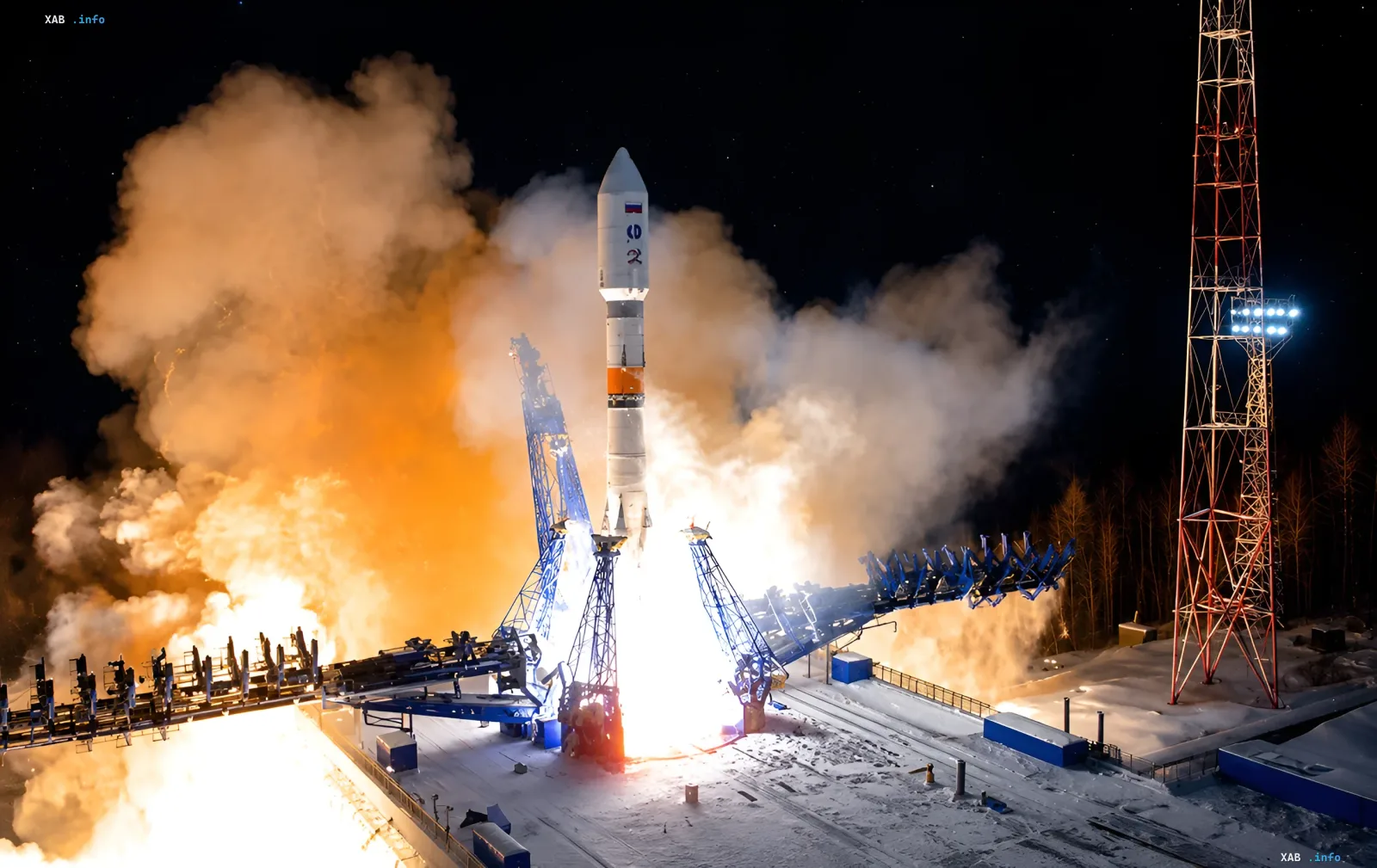
In March 2026, a significant milestone in the development of Russia's space infrastructure was announced: the first 16 serial satellites of the 'Rassvet' constellation were successfully placed into orbit. This project is positioned as a national equivalent to the American Starlink satellite communication system. The launch was carried out using the Soyuz-2.1b carrier rocket, and control of the satellites was transferred to 'Bureau 1440' — the key developer and future operator of the system.
Technical Specifications and Project Scale
The first batch of satellites reached an intermediate orbit in the spring and was taken under control. To form a full-fledged orbital constellation capable of providing global coverage, the launch of approximately 400 units is planned. Unlike SpaceX, which uses reusable Falcon 9 rockets, Russia employs single-use Soyuz-2.1b carriers.
The ground terminal of the 'Rassvet' complex is equipped with a phased array antenna and is capable of providing data transmission speeds of up to 1 Gbit/s with low signal latency. The device weighs about 15 kg, making it suitable for mobile use, including in field conditions.
Implementation Schedule and Financial Parameters
The total cost of the project is estimated at $5.5 billion. The main stages of implementation are scheduled to be completed by 2030, with the start of commercial operations planned for 2027. Defense Ministry Advisor Sergei Beskrestnov ('Flash') noted that several more launches are necessary to ensure a basic level of coverage.
"To ensure constant and stable data transmission, a minimum of 200–250 satellites must be launched. The plans for the coming years are for 300, and then another 700. We will see when and how many are actually launched. Deadlines and plans are constantly changing," he explained.
Prospects and Risks
Company 'Bureau 1440' states that by 2035, it may launch more than 900 satellites into low Earth orbit if necessary. However, experts point to possible delays: the deployment schedule may shift due to delays in launching the first batch, as well as due to the unstable quality of products from some contractors on whom the developers rely.
Nevertheless, even with the initial fulfillment of plans for 2026–2027, the Russian army will receive a reliable satellite communication tool. Earlier, the Pentagon reported that in early 2026, Ukraine managed to retake about 400 square kilometers of territory after access to Starlink was restricted for Russian users.


