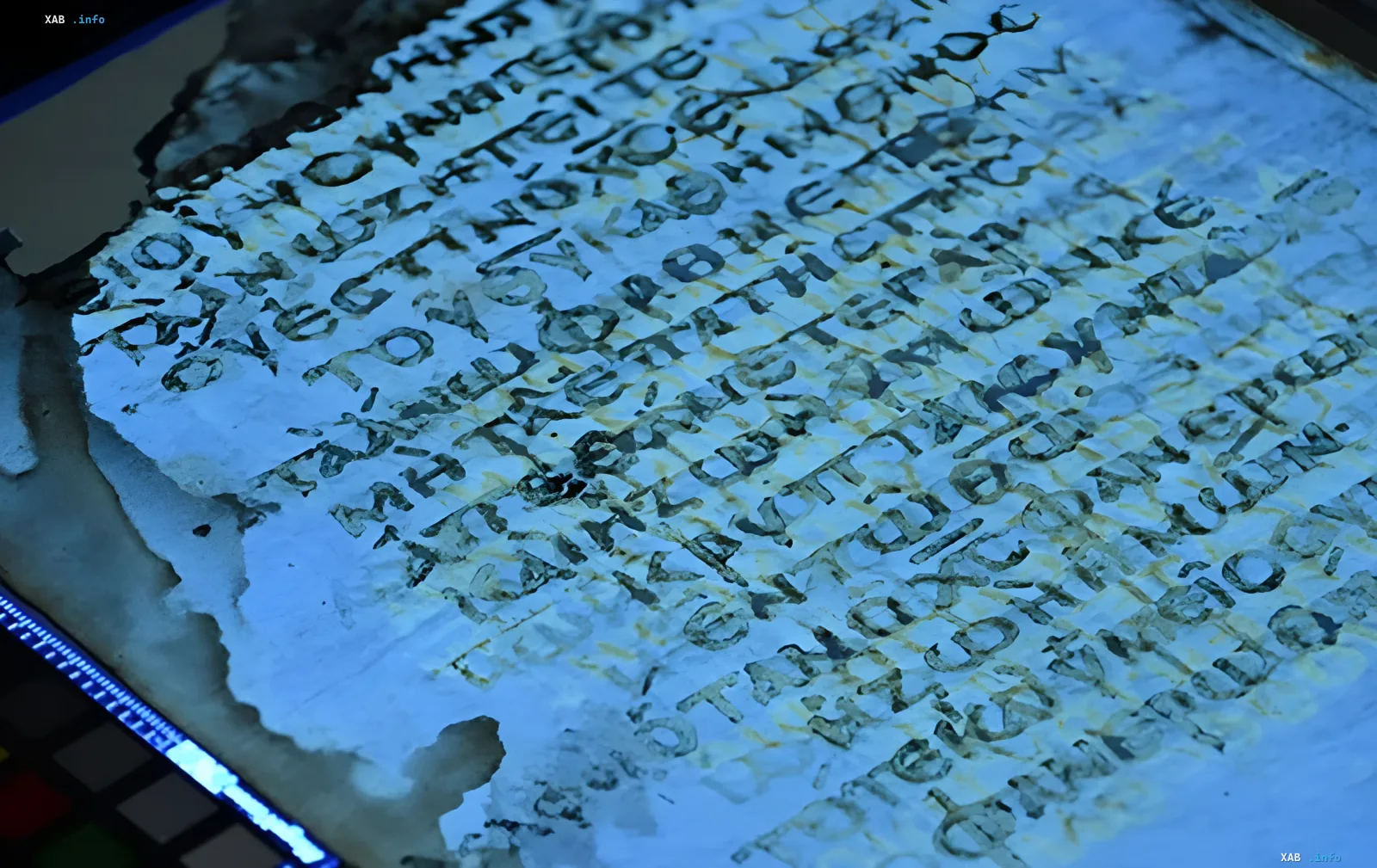
The history of ancient manuscripts is full of tragic pages, but sometimes science manages to write a happy continuation. Scientists from the University of Glasgow have made a breakthrough that seemed impossible: they reconstructed and read 42 pages of Codex H. This is one of the most important New Testament manuscripts, dated to the 6th century, which was believed to have been completely destroyed in the Middle Ages.
The Tragedy of the Parchment: How the Ancient Book Perished
Codex H originally contained the Epistles of the Apostle Paul. However, its fate took a tragic turn in the 13th century at the Great Lavra on Mount Athos in Greece. At that time, parchment was an extremely expensive material and was often reused. Monks dismantled the ancient manuscript, washed or scraped off the original text, and then cut the parchment into pieces. These fragments were used as lining and endpapers for the bindings of newer books.
As a result of this practice, the pages of the codex were scattered all over the world. Today, the surviving fragments are kept in libraries and private collections in Italy, Greece, France, as well as in archives in Ukraine. For a long time, it was believed that the text was lost forever.
Technological Breakthrough: Reading the Invisible
Bringing the lost pages back to life was achieved by a team led by Professor Garick Allen in partnership with the Electronic Manuscripts of Early Libraries (EMEL). Their method was based on the subtle physico-chemical properties of ancient materials.
When parchment was covered with new ink in the Middle Ages, aggressive chemical components penetrated deep into the structure of the skin. This led to so-called "mirror displacement" on adjacent pages. These chemical traces are completely invisible to the human eye, but they were preserved for centuries.
Scientists used multispectral imaging. Special light filters and image processing algorithms allowed them to capture the "ghostly silhouettes" of the original letters. In fact, researchers managed to extract several pages of information from a single physical sheet that, at first glance, looked like an empty lining.
Confirmation of Authenticity and Scientific Value
To finally confirm the historical authenticity, experts in Paris conducted radiocarbon dating. The analysis showed that the parchment indeed dates back to the 6th century.
Although the restored fragments contain already known sections of Paul's Epistles, their textual value is colossal. Professor Allen called the volume and quality of the discovered data "monumental". Here is exactly what was learned:
- Oldest copies of sections: On the restored pages, the oldest known copies of the contents of Paul's Epistles were found. They demonstrate the structure and division of the text, which is radically different from the modern system adopted in Christianity.
- Secrets of the Scribes: The fragments vividly show how scribes of the 6th century interacted with the text. Scientists saw where they made mistakes, how they corrected them, what notes they left in the margins, and how they commented on complex theological points.
- Everyday history of books: The condition of the material reconstructs in detail the practice of medieval "recycling," showing what happened to sacred books after they wore out.
Access to Knowledge
The University of Glasgow has already opened free digital access to the restored pages of Codex H on a specialized portal. A full-fledged printed scientific edition is planned for release soon, which will return this lost masterpiece after eight centuries of oblivion.


