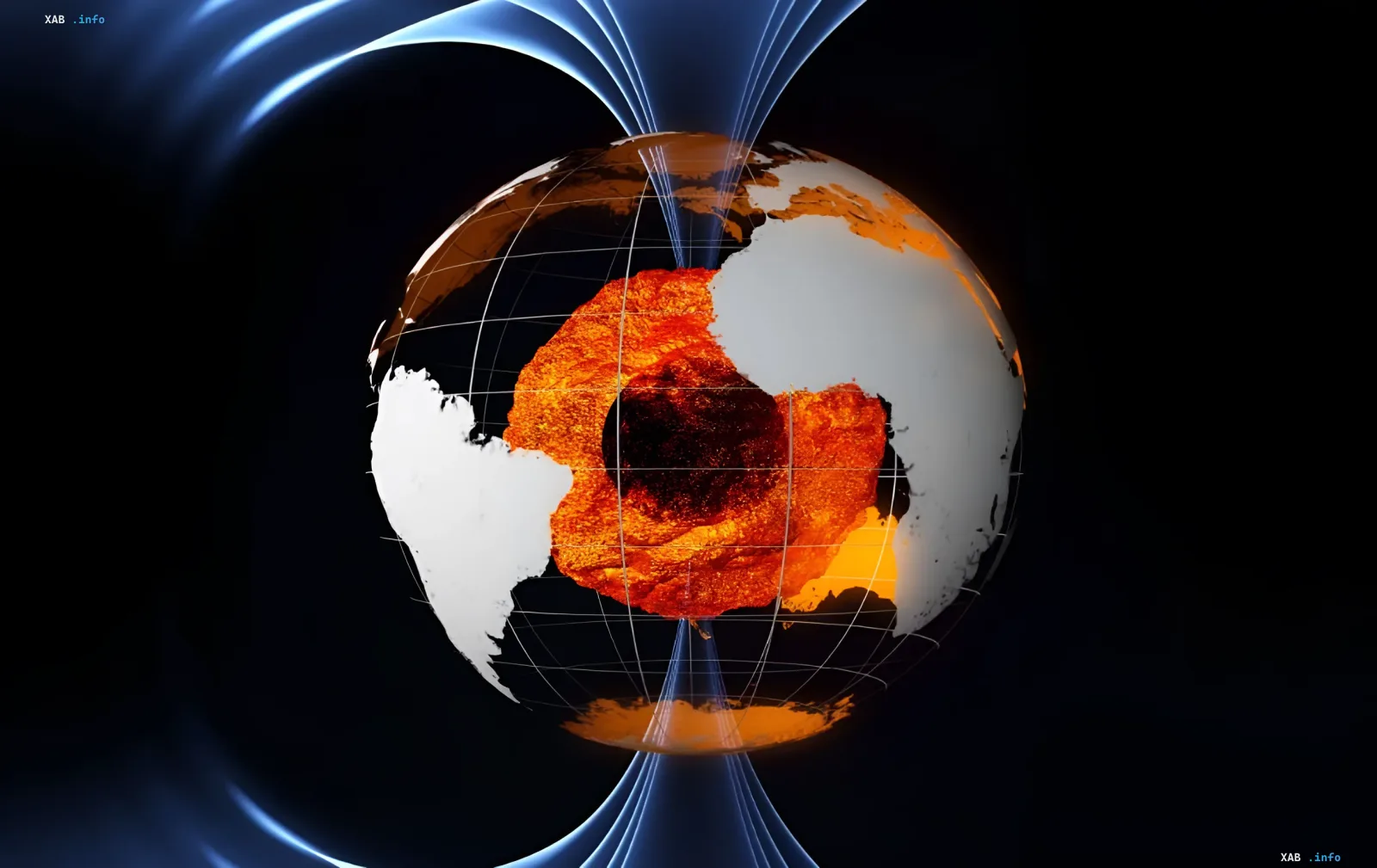
A significant event has occurred deep within our planet, prompting the scientific community to reevaluate established theories regarding the evolution of the magnetic field. Scientists have discovered an unexpected anomaly: massive currents of molten iron circulating beneath the Pacific Ocean have suddenly and sharply changed their direction of flow.
Details of the discovery, published in the Journal of Studies of Earth's Deep Interior, indicate that the Earth's outer core behaves much more dynamically than theoretical models had assumed.
Glitch in the Geodynamo
Earth's magnetic field is an invisible shield protecting the atmosphere, living organisms, and modern technological systems from devastating solar radiation and streams of charged particles. This protective mechanism is powered by the "geodynamo" — a process generated by the constant movement of molten, electrically conductive iron in the planet's outer core, located at depths between 2,200 and 3,000 kilometers.
For a long time, scientific consensus held that these deep currents are extremely stable and change their course very slowly — over decades or even centuries. However, an analysis of data collected between 1997 and 2025 has refuted this theory.
In the equatorial region of the Pacific Ocean, an "iron river" that had previously been moving weakly westward was recorded. Suddenly, it executed a sharp maneuver and began flowing powerfully eastward. This tectonic reversal occurred in just a few years.
How Scientists Saw the Invisible
While it is physically impossible to look inside the Earth, the movement of metal leaves unique magnetic imprints on the planet's surface. To detect such a subtle anomaly, scientists utilized the Swarm satellite constellation launched by the European Space Agency (ESA), as well as data from the CHAMP, CryoSat, and Ørsted satellites.
Recent simulation data shows that after reaching peak intensity, this eastern current beneath the Pacific Ocean began to weaken. This observation suggests that the recorded reversal is either a short-term fluctuation or part of a longer natural cycle that was previously unknown to humanity.
Layer Interaction and Impact on Technology
Scientists emphasize that these processes occur too deep to pose any threat to human life or the climate on the surface. Nevertheless, understanding the mechanisms of the core is critically important for modern civilization. Shifts in the depths directly affect global navigation systems, the operation of spacecraft, and the accuracy of space weather models.
The authors of the study hypothesized that the sudden reversal beneath the Pacific Ocean occurred synchronously with anomalous changes in the behavior of the Earth's inner solid core, which had previously been recorded by geodesists and seismologists.
This discovery proves that the deepest layers of our planet are interconnected much more closely than previously thought. The boundary between the core and the mantle turns out to be a zone of extremely turbulent and complex processes that continue to surprise researchers.


