
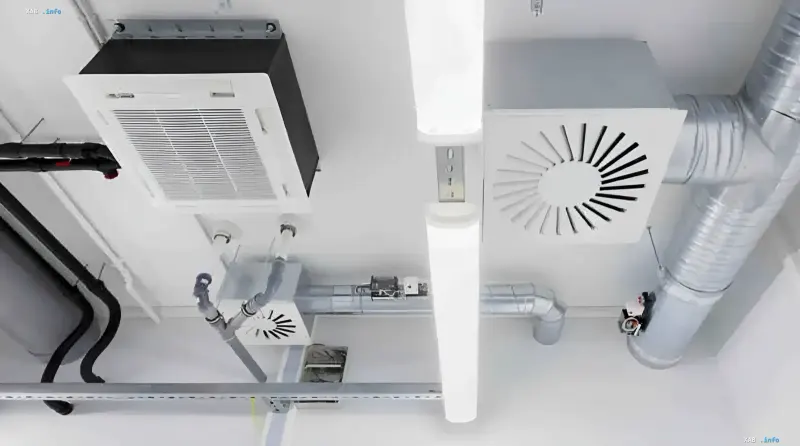
In Western European countries, where summer temperatures are setting record highs, the construction industry is undergoing a technological shift. Traditional split systems, which have become a familiar attribute of hot summers, are gradually giving way to more complex but effective solutions. In modern residential complexes, architects and engineers are increasingly choosing surface (radiant) cooling systems, integrating climate control directly into the building structure.
This transition is not accidental. According to industry publications, including The Times, the implementation of such systems is a key element of the strategy to create energy-efficient and carbon-neutral buildings. But how exactly does this technology work, and why is it becoming the standard for comfortable living in the context of global warming?
The physics of comfort: the principle of radiant cooling
The surface cooling technology is based on a principle opposite to the familiar water 'underfloor heating'. Instead of heating the floor, the system cools the ceilings or walls. Inside the enclosing structures, a closed network of thin polymer pipes is laid, through which water circulates at a temperature of +14 °C to +18 °C.
The heat exchange mechanism here is fundamentally different from the operation of classic air conditioners. Compressor units drive streams of cold air, creating zones of turbulence and drafts. The radiant system works differently: heated air naturally rises to the ceiling, where its excess heat is absorbed by the cold surface via radiative heat exchange.
The result is uniform cooling of the entire room volume. There are no local zones of cold or heat in the room, the noise level is minimal, and the risks of catching a cold due to being blown by cold air are reduced to zero.
Energy efficiency versus capital costs
Engineering authorities highlight a number of operational advantages that make this technology attractive for the long-term perspective:
- Reduced energy consumption: The electricity consumption of radiant systems is on average 20–30% lower than that of traditional air conditioners of comparable power. This is achieved due to the higher operating temperature of the refrigerant and the lack of need for powerful fans.
- Preservation of microclimate: Unlike split systems, which tend to dry out the air, water circuits do not affect relative humidity, maintaining natural comfort in the room.
However, the technology has its own challenges. The main challenge is the risk of condensation forming on the cooled surface if the temperature drops below the 'dew point'. To prevent this, modern systems are equipped with complex automation: humidity sensors and valves that adjust the water temperature, as well as integration with supply and exhaust ventilation.
A significant barrier to mass implementation remains economic factors. The initial capital costs for design, equipment procurement, and installation of water circuits in walls and ceilings at the construction stage significantly exceed the cost of installing standard split systems.
The need for passive protection
Specialists in the field of energy-efficient architecture emphasize: even the most advanced engineering systems will not work effectively without the support of passive methods of protecting buildings from insolation.
The key element here is external screening. The use of external blinds, awnings, and sun protection roller shutters allows up to 80–90% of the sun's thermal energy to be stopped before it penetrates through the glazing. Internal curtains are ineffective in this context, as they only redistribute heat already inside the room.
Also, the correct ventilation mode is critically important. It is recommended to keep windows closed during hours of peak solar activity. Cooling and ventilation using outside air are shifted to the night and early morning hours to avoid overloading engineering systems with hot air.


