
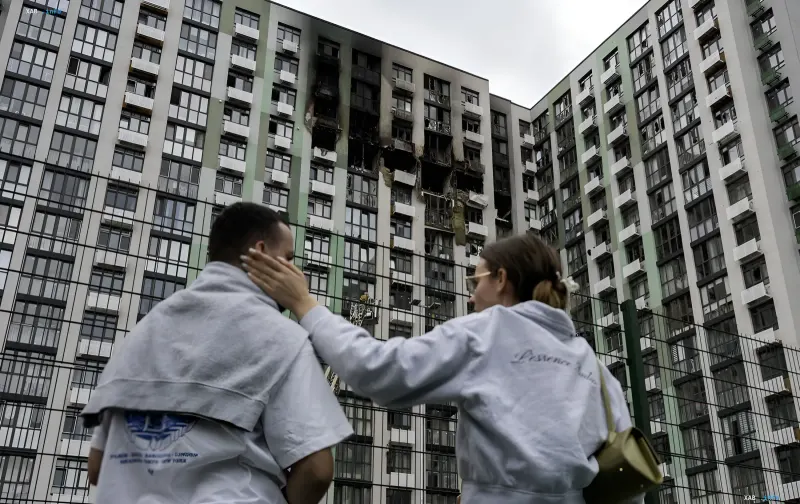
Kyiv and the Kyiv region are being subjected to intense strikes by the Russian armed forces for the sixth consecutive day, with jet-powered unmanned aerial vehicles playing an increasingly prominent role in the enemy's tactics. According to Anton Zemyany, a senior analyst at the Ukrainian Center for Security and Cooperation, the intensity of strikes toward the capital remained critically high between August 27 and the end of the month. The drones enter Kyiv predominantly from the northern direction — from the border with Belarus — and then head toward the city across the Kyiv Reservoir. In just four days, the enemy launched around 1,500 drones, of which 800 were jet-powered.
Rapid Growth in the Use of Jet-Powered UAVs
The trend toward expanding the use of jet-powered drones has been rapid: in July of this year, the enemy increased their use fivefold compared to the previous period, and by August the cumulative figure exceeded 2,800 units. At the same time, according to the Ukrainian Air Force, the shoot-down rate for jet-powered drones is around 60%, while the effectiveness of countermeasures against "conventional" strike drones reaches 90–95%. Despite these figures, Russian attacks continue to result in hits that cause infrastructure damage and human casualties. According to available information, in recent strikes the Russians used jet-powered drones manufactured in July or August, indicating an attempt by the Russian military-industrial complex to maintain the pace of strikes almost "off the assembly line."
Tactics of Continuous Alert and the Time Frame of the Campaign
As Zemyany notes, the occupiers launch jet-powered drones in small groups in order to maintain a virtually continuous air alert in Kyiv. It is difficult to predict the exact time frame of such a campaign, since the intensity depends on the enemy's current capabilities and the objectives of the Russian command. Nevertheless, the analyst links the continuation of the strikes to the Russian political calendar: "Obviously, this could continue until the 'elections' for the Russian State Duma, which will take place at the end of September (from September 18 to 20). This is done to create a media effect of 'victory' among the Russian public." The key limiting factor, however, remains the capacity of the Russian military-industrial complex: "They are essentially launching weapons almost off the assembly line to maintain the intensity. And this may well be the thin limit at which they simply will not be able to keep up the pace due to a shortage of drones."
Geography of the Strikes and the Threat to Western Regions
The main directions of Russian strikes remain the Kyiv region and the border regions in the north, southern Ukraine, as well as the frontline regions — Dnipropetrovsk, Zaporizhzhia and Kharkiv. According to Zemyany, this geography is consistent with the overall Russian campaign to weaken Ukraine by striking logistics and critical infrastructure. The analyst considers it unlikely that large-scale attacks will expand to the western regions as long as the Russian command does not change its target priorities. However, the potential threat to western Ukraine persists constantly. "The latest jet-powered drones, such as the 'Geran-4' or 'Geran-5', are capable of penetrating deep into the rear thanks to their high-altitude flight. Cases have already been recorded in which jet-powered UAVs covered up to 900 km across Ukrainian territory. Given that, according to GUR estimates, the potential range of the 'Geran-5' reaches up to 1,000 km, the entire territory of the country potentially remains under threat," the analyst concluded.
Contradictory Data
It should be noted that the sources used for fact-checking describe events at different times. The RBC-Ukraine material (the main source of the article) documents the current six-day strike campaign and relies on estimates obtained from an analyst at the Ukrainian Center for Security and Cooperation, including predictive judgments about the continuation of attacks until the end of September. The RFI source (day 1169 of the war) describes a separate incident that occurred in May 2025, in which two people, including a child, were killed in Kyiv. No direct contradictions in figures or dates between the two sources have been identified; however, they relate to different time frames and cannot mutually confirm or refute each other. In addition, the specific drone model names ("Geran-4", "Geran-5") and their stated range (up to 1,000 km) are given based on GUR and analyst estimates, rather than on the results of independent verification, which requires caution in interpretation.


