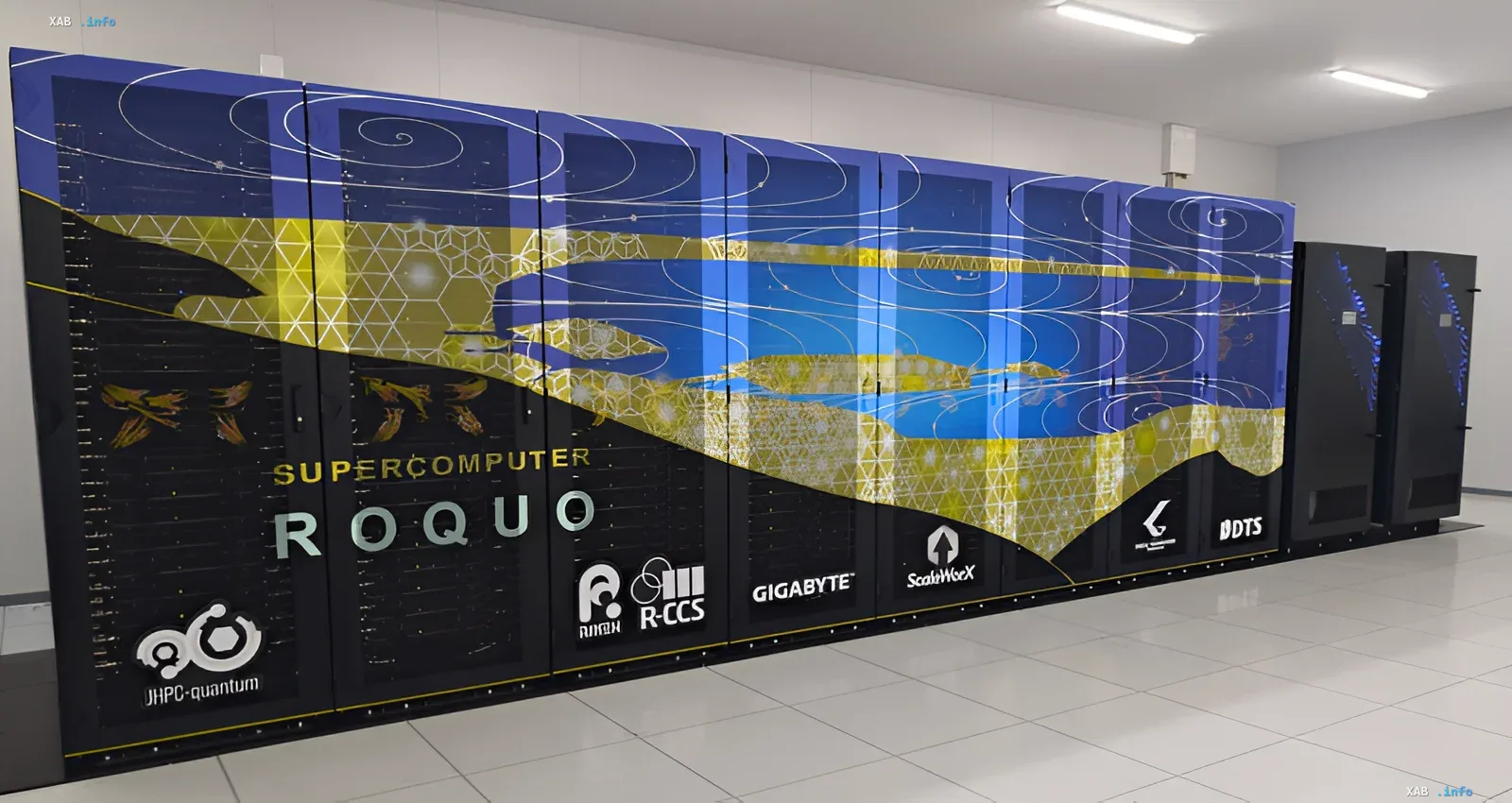
At the RIKEN Center for Computational Science (R-CCS), two of the world's most powerful high-performance computing complexes — RIKYU and ROQUO — have officially begun operations. Both supercomputers are built on NVIDIA's cutting-edge hardware platform and are designed to tackle the most resource-intensive tasks in artificial intelligence.
RIKYU: The engine for foundational AI models
The RIKYU system is focused on creating open foundational models (foundation models) and conducting large-scale research in fields such as life sciences and materials science. The architecture of the complex is based on 400 Supermicro PIO-121GL-NBIB-01 compute nodes. Each node is built on the NVIDIA GB200 NVL4 platform, which combines two Grace processors and four Blackwell accelerators connected via a high-speed NVLink bus.
To ensure stable operation of such a powerful configuration, liquid cooling and a modern InfiniBand XDR interconnect with a bandwidth of 800 Gbit/s have been implemented. Additionally, the supercomputer includes 16 Supermicro SYS-212HA-TN nodes equipped with Intel Xeon 6980P processors (Granite Rapids-AP architecture), 1.5 TB of RAM, and fast NVMe SSD-based storage.
RIKYU's performance is impressive: in FP64 mode, it reaches 59.63 petaflops, and in FP8 mode — 15.539 exaflops.
ROQUO: Hybrid quantum-classical computing
The second complex, ROQUO, was designed with a specific goal — to support hybrid quantum-classical algorithms. The system consists of 135 compute nodes based on the same powerful NVIDIA GB200 NVL4 chips. Node-to-node communication is provided by the NVIDIA Quantum-X800 InfiniBand interconnect with a bandwidth of up to 3.2 Tbit/s, and liquid cooling is also used.
In FP64 mode, ROQUO's performance is 19.8 petaflops (peak value — 21 petaflops), and its performance in FP8 mode exceeds 5 exaflops. A key feature of ROQUO is its ability to operate in conjunction with the Quantinuum Reimei and IBM Quantum System Two quantum systems.
A unified research platform
The launch of RIKYU and ROQUO creates a unified ecosystem for Japanese scientists. While RIKYU handles resource-intensive classical AI tasks, ROQUO opens up possibilities for combining classical computing with quantum methods. This flexible combination provides researchers with a unique toolkit for working with the most complex models and solving comprehensive problems that were previously inaccessible.