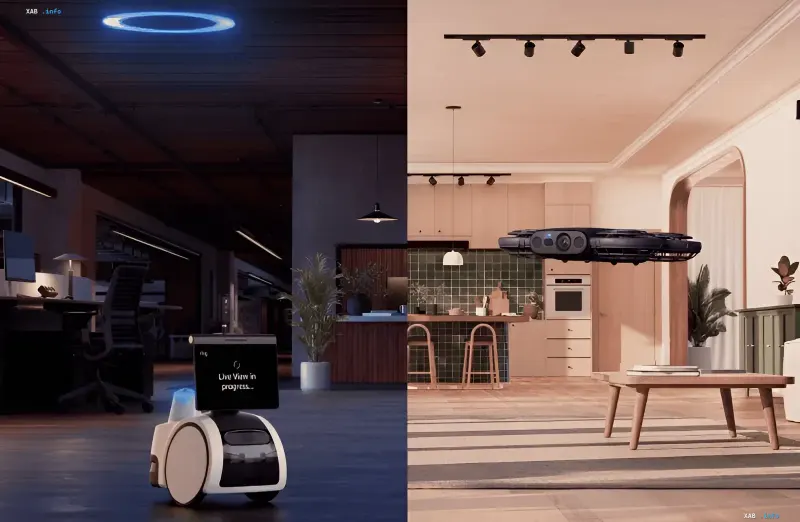
Ring, an Amazon-owned company, has unveiled two new devices, which it positions as the first products in its "autonomous mobile security systems" line under the Ring Robotics brand. The lineup includes Ring Drone Cam, a flying surveillance camera for residential spaces, and Ring Rover Cam, a mobile patrol robot designed for commercial facilities. Both devices are united by a single technological platform, AI Pilot, which enables autonomous navigation, room mapping, and intelligent identification of areas requiring constant monitoring.
Flying camera: coverage where stationary devices cannot reach
Ring Drone Cam is a compact multi-rotor drone equipped with a surveillance camera. Unlike traditional stationary cameras fixed to walls or ceilings, the drone can move along pre-set routes inside a space and "peek" into areas that remain outside the field of view of fixed devices. According to the developers, this solves the main problem of home security — blind spots. The device is intended for indoor use only and is not designed for outdoor operation.
Patrol robot for business: autonomous round-the-clock monitoring
Ring Rover Cam is oriented toward commercial facilities, such as offices, retail spaces, and warehouses. The robot autonomously patrols the area, checks locations where incidents were previously recorded, and streams video in up to 4K resolution. Unlike the drone, Rover Cam operates on a wheeled chassis, ensuring smoother and more predictable movement on flat surfaces. The device is designed for conditions where a permanent security guard is not cost-effective, but monitoring of the perimeter and key zones is required.
AI Pilot: how devices "see" and "understand" space
At the core of both devices lies the AI Pilot system, a comprehensive solution combining camera data, specialized computer vision models, built-in sensors, and cloud computing. During the setup phase, one simply needs to carry the Ring Drone through the space or let the Ring Rover explore it on its own: the system transforms what it sees into a floor plan, intelligently recognizes rooms, and suggests patrol waypoints such as side doors, windows, cash registers, or long hallways. The user can also add their own points based on specific room requirements. During operation, AI Pilot charts the most efficient route and navigates around obstacles in real time, responding to environmental changes.
Design as a deterrent and data protection
Both devices are designed to make their presence as noticeable as possible. The propellers of the Ring Drone create a characteristic noise, and the Ring Rover is equipped with a bright light beacon. If an intruder is detected on the premises, the drone or robot activates visual and auditory alerts, letting the intruder know they have been spotted. Video recordings from both devices are protected by Throw Away the Key (TAKE) encryption, ensuring the privacy of the recorded content.
Pricing, timing, and context: lessons from the previous Astro project
Ring Rover Cam will go on sale in the US on December 16, 2026, for $999.99. Shipments of Ring Drone Cam to US customers will begin on January 27, 2027, for $249.99. For comparison, Amazon's previous attempt to establish itself in the robotics market — the home robot Astro, introduced in 2021 for $1,450 — was limited in scope: the device was sold by invitation only and reached a few thousand buyers, while the later corporate version was shut down in less than a year. Founder and chief inventor of Ring Jamie Siminoff explained the logic of the new approach: "The solution was not just to add more cameras, but to rethink the very concept of a security device. This is the beginning of a future in which proactive, autonomous protection becomes available to every home and every business."