
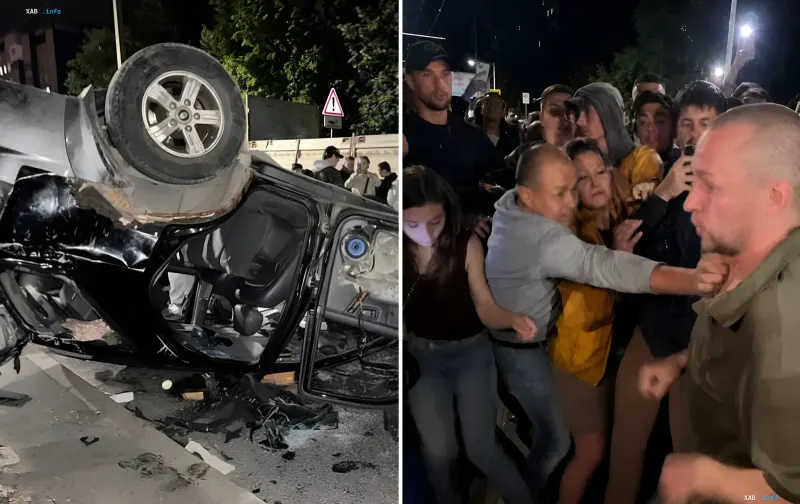
The night of July 9 in Lviv marked a sharp escalation of tension surrounding the issue of mobilization. An incident in which a group of civilians clashed with representatives of the Territorial Recruitment and Resource Center (TRRC) escalated into mass disorder. Videos circulating online capture dramatic scenes: a military vehicle being overturned and an aggressive mob attacking uniformed personnel, tearing off their clothes.
Police injuries and criminal cases
The events of the night of July 9 attracted the attention of law enforcement agencies. The Prosecutor's Office has already launched an investigation into the circumstances of the incident, which involved approximately 200 civilians, police officers, and TRRC staff. The department reported the opening of two criminal proceedings.
The grounds for the investigation were facts of obstructing the lawful activities of the Armed Forces of Ukraine during the special period and the use of violence against a law enforcement officer. According to the Prosecutor's Office, one of the participants in the clashes beat the head of one of the district departments in Lviv. The law enforcement officer sustained numerous physical injuries and head trauma.
Government reaction: from "a place in hell" to calls for wisdom
The events caused a wide resonance among representatives of the authorities, each of whom attempted to assess what happened.
Military Ombudsman Olga Reshetilova took the bold step of shifting responsibility not only to the citizens who took to the streets but also to the authorities, the military-political leadership, and local self-government bodies. In her opinion, the situation was exacerbated by politicians using the mobilization issue for their own publicity instead of addressing the problems substantively.
"A complete review of the principles of deferment is needed, from which the mobilization reform should begin. But to implement this, political will is not enough, nor is a team of powerful bureaucrats; it also requires public support, which is currently lacking," Reshetilova stated.
The Head of the President's Office of Ukraine, Kirill Budanov, addressed the participants of the conflict with a stern warning. He urged them to think about the consequences of their actions against their own army.
"If today you tear off the clothes and beat a serviceman of your own army, think about who will protect you tomorrow from the enemy army, which will also beat and tear off clothes, but from you," Budanov wrote, adding that he expects a fair reaction from law enforcement.
Lviv Mayor Andriy Sadovoy called what was seen a "very bad phenomenon" and a "symptom" of deeper problems. He reminded that 58,000 residents of Lviv are currently at the front, and the city is suffering losses and spending a significant part of its budget on supporting the Defense Forces. Sadovoy emphasized that Russia is most interested in Ukrainians starting to fight among themselves, turning internal conflicts into a tool of hostile propaganda.
"The videos we saw yesterday are sadness and shame. Be wise!" the mayor urged, calling for an end to calling servicemen "TRRC workers" and taking the law into one's own hands.
Cause of the conflict and the Ministry of Defense's position
According to information from the Lviv TRRC, the immediate cause of the conflict was an attempt to deliver a man wanted by authorities to undergo a military-medical commission (MMC). Another notification group remained at the scene, which was blocked by unknown individuals. They cordoned off the official transport, behaved aggressively, significantly damaged the vehicle, and eventually overturned it.
The Ministry of Defense of Ukraine urged the Lviv Regional Police to provide a legal assessment of the situation. The department noted that the only beneficiary of such events is the enemy. "The language of hatred towards one's own army will lead to irreparable changes. Mobilization is a necessary component of Ukraine's defense. Its methods need improvement, and this process is ongoing," the Ministry of Defense stated.
The Verkhovna Rada Commissioner for Human Rights, Dmytro Lubyntsev, linked the conflict to long-standing systemic problems. According to him, when people report human rights violations during mobilization for years and see no legal assessment, distrust accumulates, and society radicalizes. Lubyntsev insists on the necessity of reforming mobilization processes already today.
The Head of the Lviv Regional Military Administration, Maksym Kozitsky, confirmed that a meeting with law enforcement officers took place in the city at night. According to him, all those who committed offenses must be identified and held accountable.


