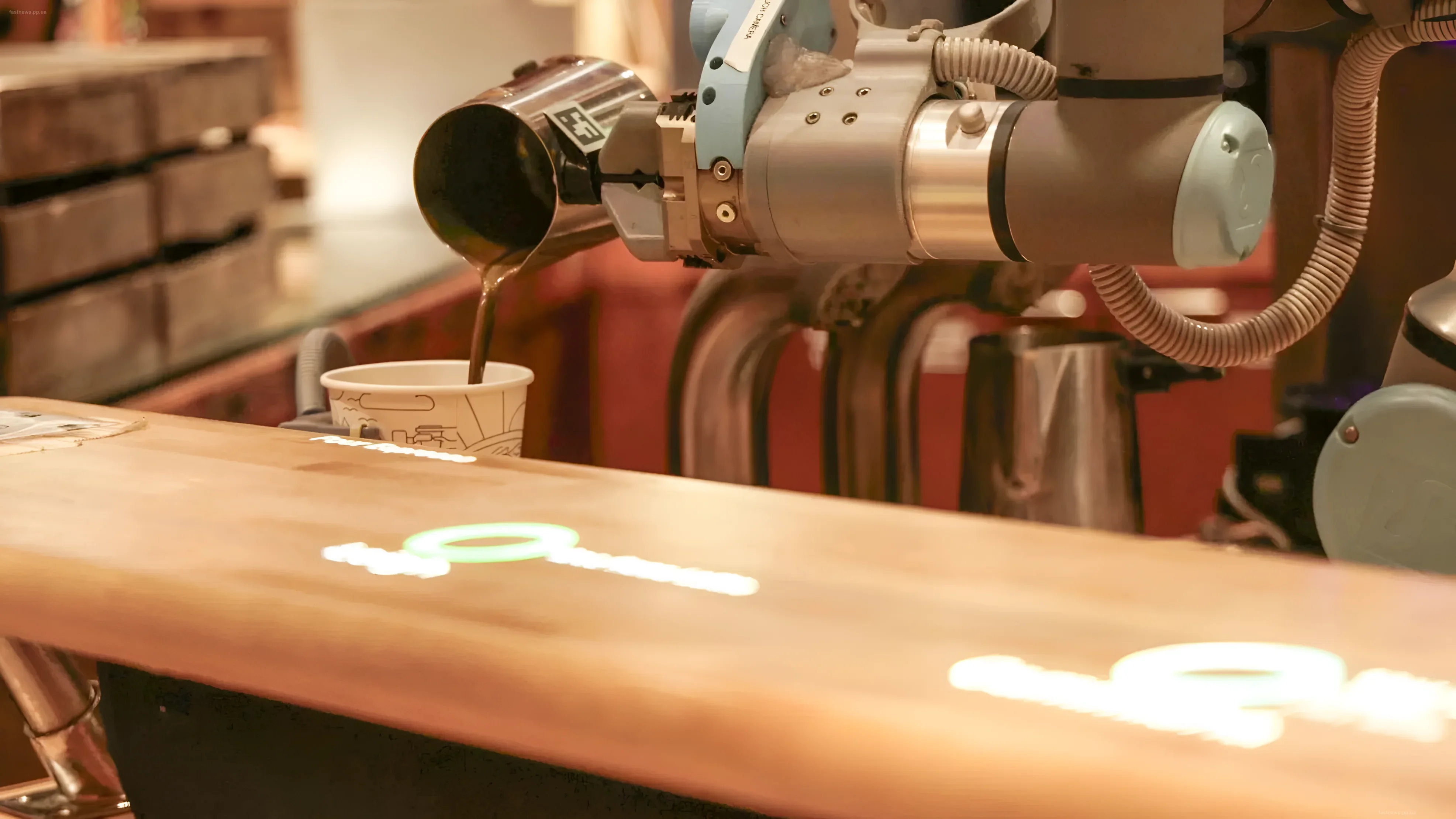
A new employee has appeared at Muji coffee shops in Portland who doesn't need breaks, doesn't get tired, and never misses an order. This is Jarvis — a robotic barista from the American startup Artly. His task is not just to serve a cup of coffee, but to replicate the skill of a latte art champion with precision down to 0.1 grams.
From Craft to Algorithm
Artly set an ambitious goal: to transform the preparation of artisanal coffee from an art dependent on the barista's mood into a scalable service. However, instead of creating yet another "coffee machine," the developers took a different path. They created a system that imitates human movements, including milk frothing techniques and pattern drawing.
The project is based on the experience of Joe Young — a legendary roaster and winner of US coffee mastery championships. He currently holds the position of Chief Coffee Officer at Artly. His journey into the industry began by chance in New Zealand, where he ordered an espresso simply because it was the cheapest drink on the menu. Today, his movements serve as the benchmark for the robot.
How the Robot Learns Creativity
To train Jarvis, the team used a motion capture system. Sensors were attached to Joe Young's hand, recording every movement made while creating latte art. The robotic arm does not just repeat an animation; it reproduces the actual technique. Furthermore, the system is equipped with computer vision: after preparation, Jarvis photographs the result and analyzes it. If the pattern does not meet the standard, the algorithm adjusts the parameters for the next attempt.
The robot's precision is impressive: ingredient control is maintained with a margin of error of only 0.1 grams. The system monitors extraction time, temperature, water level, and even the angle of the steam wand. Joe Young personally configured these parameters so that the robot could brew coffee exactly as he does.
Stability vs. The Human Factor
Jarvis's main advantage is stability. In a real coffee shop, baristas work in conditions of noise, haste, and a stream of orders. Fatigue or inattention can spoil the taste of the drink. According to Young, during peak hours, the robot often handles the task better than a human, guaranteeing consistently high quality for every cup.
However, Jarvis does not work fully autonomously. Coffee shop staff still handle restocking beans, milk, and cups. The robot takes care of preparation, cleaning, and quality control, constantly checking tamping pressure and cup placement using cameras and sensors.
The Future Belongs to Automation
The Jarvis project is just the beginning. Artly is already testing robotic systems for preparing cocktails, smoothies, and is even working on automatic fish processing. Robots can also work at service stations, indicating broad prospects for implementing AI in various service sectors.
If you want to personally evaluate Jarvis's work, Joe Young recommends ordering a latte. This drink best demonstrates the system's capabilities in creating latte art and frothing milk. Jarvis shows how robotics and artificial intelligence are moving from experiments to everyday services, offering stable quality where human craftsmanship once reigned.


