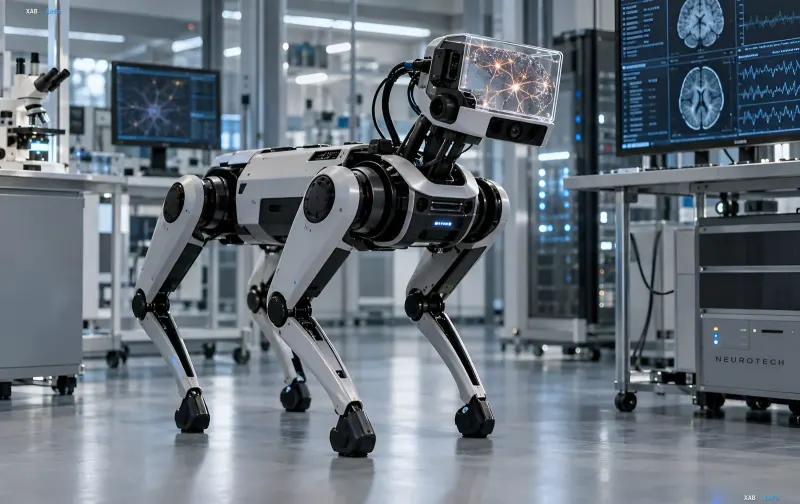
Australian company Cortical Labs has unveiled a robot dog controlled not by a silicon processor, but by a biological "brain" made of living neurons. Laboratory-grown brain cells were placed directly onto a chip with electrodes, translating their activity into real machine movement. This was reported by RBC-Ukraine with reference to a fresh study published on the arXiv preprint server.
Living Neurons Instead of Silicon
According to the scientists, living neurons could serve as the foundation for computer chips and prove more efficient than traditional silicon processors. The human brain consumes significantly less energy than modern AI systems and adapts better to unfamiliar environments. The Australian team grew neurons directly on the surface of the microchip and equipped it with electrodes for two-way electrical signal transmission. This allowed the activity of a small group of cells to be converted into controlled movement of the robotic dog.
From Virtual Games to Real Movement
Previously, Cortical Labs demonstrated how cultured neurons performed computer tasks—specifically playing classic games like Pong and Doom. Now, the company aims to take the technology beyond the virtual world and has partnered with the European research institute Honda Research Institute Europe. During the experiment, special feedback loops continuously adjusted the device's direction, helping it reach a target destination on a simple map.
Thousands of Hours of Training in a Virtual Environment
As part of the collaboration, the scientists conducted a prolonged experiment in a virtual system where the living chip searched for rewards in a basic grid. Over 4,000 hours of continuous interaction, nearly 1,300 different signal combinations were tested. Honda senior researcher Daniel Tanneberg emphasized that using living cells as a computing substrate opens up significant potential for adaptability and energy efficiency in future intelligent agents.
Prospects and Current Limitations
The researchers note that modern robots can already run well and perform complex acrobatic stunts, but still struggle with higher-order decision-making and adapt poorly when conditions suddenly change—a problem the "living" chip aims to solve. Currently, biological chips are in the early stages of development and do not boast high speeds or pinpoint accuracy. In the future, such systems could operate in hazardous or remote areas and provide personalized assistance while continuously learning in the process. The main challenge for engineers is not just growing cells on silicone, but finding reliable ways to interface with biological systems, learning to train them stably, scaling chips for more complex tasks, and understanding how living neurons store information and form memory.