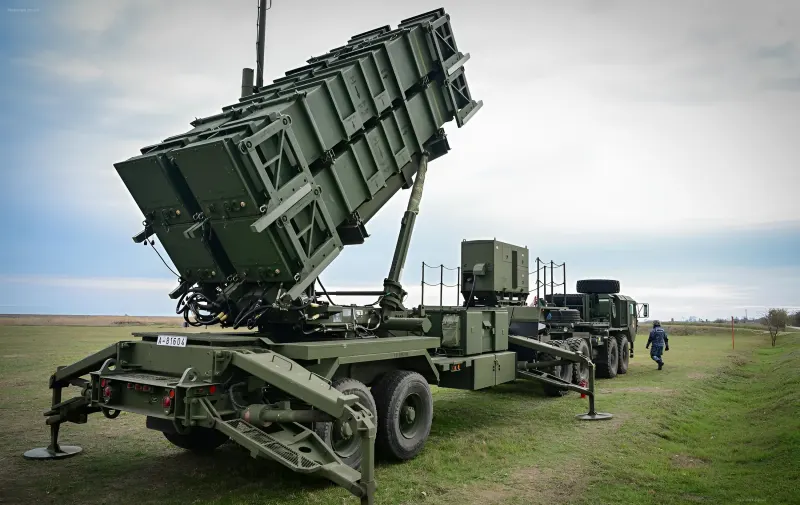
Romania, whose skies have become the scene of tense events in recent months, has officially appealed to NATO to accelerate the delivery of air defense systems. The reason for such decisive action was an incident in the city of Galați, where a Russian drone that violated the country's airspace crashed into a residential building.
The Incident in Galați: Consequences and Reaction
On the night of May 29, during a massive Russian attack on the Odesa region, an enemy drone crossed the border and crashed onto the roof of an apartment building in the Romanian city of Galați. As a result, a fire broke out, and two people sustained minor injuries. Romanian Foreign Minister Oana Tincu called the incident "unacceptable and a blatant violation" of the country's airspace.
At the time of the incident, two F-16 fighters were scrambled, but they failed to shoot down the drone because the threat emerged directly over a populated area, making the use of weapons impossible.
Demands to NATO and Defense Modernization
The head of the Romanian Ministry of Foreign Affairs confirmed that NATO Supreme Allied Commander General Alexus Grinkevich supported Bucharest's previous proposals regarding the relocation of military equipment. Now, Romania is insisting on accelerating these deliveries. Interim Prime Minister Ilie Bolojan clarified that the country is asking its partners to provide specialized radars for detecting low-altitude targets.
The Alliance is already assessing the possibilities for optimizing Romanian air defense systems. In particular, the issue of transferring the domestic anti-drone system MEROPS to NATO command is being considered. At the same time, Romania does not currently plan to invoke Article 4 of the NATO treaty regarding urgent consultations.
Diplomatic Response and Moscow's Reaction
In addition to military requests, Bucharest has taken tough diplomatic steps. The Romanian Ministry of Foreign Affairs summoned the Russian ambassador and also announced the closure of the Russian General Consulate in the city of Constanța and the expulsion of the general consul from the country.
In response, Russian Foreign Ministry spokesperson Maria Zakharova threatened Bucharest with a "response," while Deputy Chairman of the Security Council of Russia Dmitry Medvedev stated that EU countries "need to shut up on this issue." Meanwhile, the European Union expressed outrage over the incident: European Commission President Ursula von der Leyen emphasized that Russian aggression has "crossed another line."


