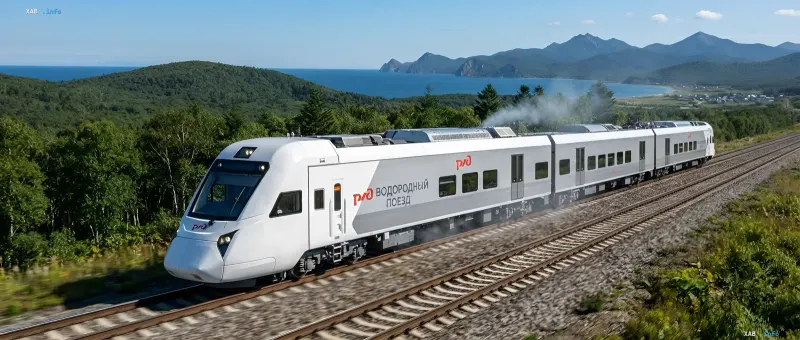
The Demikhovo Machine-Building Plant has completed the assembly of Russia's first passenger train powered by hydrogen fuel cells. According to the enterprise, assembly of a second trainset is underway in parallel. The vehicles are designed for operation on non-electrified 1,520 mm gauge railway sections and are viewed as a direct alternative to diesel traction units currently serving a significant portion of such lines.
Zero Emissions: How the Power Plant Works
The train's operation is based on hydrogen fuel cells that generate electricity for propulsion; during operation, the power plant produces no harmful emissions, and its "exhaust" consists of water vapor. If necessary, the trainset can switch to onboard battery power. According to Alexander Loshmanov, Deputy CEO of Transmashholding JSC, the power plant was entirely developed in Russia and designed taking into account domestic operating conditions, as well as strict safety and certification requirements.
Russia's First Low-Floor Electric Train
The hydrogen trainset has simultaneously become the country's first low-floor electric train. The carriage design allows passengers to board from platforms of varying heights without climbing high steps, simplifying boarding and alighting and improving transport accessibility for passengers with limited mobility. According to available data, the three-car hydrogen trainset has a range of approximately 725 km.
Sakhalin as a Pilot Site and Certification Timelines
The first train is planned to be sent to Sakhalin, where it will serve non-electrified railway sections as part of the development of the regional hydrogen cluster. The project is being implemented by Transmashholding enterprises jointly with Russian Railways and the government of the Sakhalin Region with the support of the Ministry of Industry and Trade. According to industry representatives, the entire testing complex is planned to be completed by the fourth quarter of 2027, and a certificate of conformity and launch into test operation are expected in the same quarter.
Context: Focus on Hydrogen Mobility
The emergence of this trainset fits into a broader course toward diversifying traction on non-electrified lines and reducing the carbon footprint of railway transport. For the Sakhalin Region, the project has a dual meaning: it solves the practical task of servicing lines without an overhead catenary network and forms an element of the region's hydrogen infrastructure. The outcome of the initial tests and certification will be a decision on the serial production of the trainset and the possible expansion of the hydrogen train route network.