The Stockholm International Peace Research Institute (SIPRI) recorded in its 2026 annual report, "World Nuclear Forces," that Russia has increased the number of deployed—i.e., ready-for-use—nuclear warheads for the fourth year in a row. As of January 2026, 1,796 such warheads were on delivery vehicles, the highest figure in the past nine years, since 2017. The growth trend is consistent: in 2022 there were 1,588 deployed warheads, in 2023 — 1,674, in 2024 — 1,710, in 2025 — 1,718, and by the start of 2026 the figure rose to 1,796. Compared with 2020, Moscow has expanded its deployed arsenal by roughly 14%.
Total Arsenal and the Triad of Delivery Vehicles
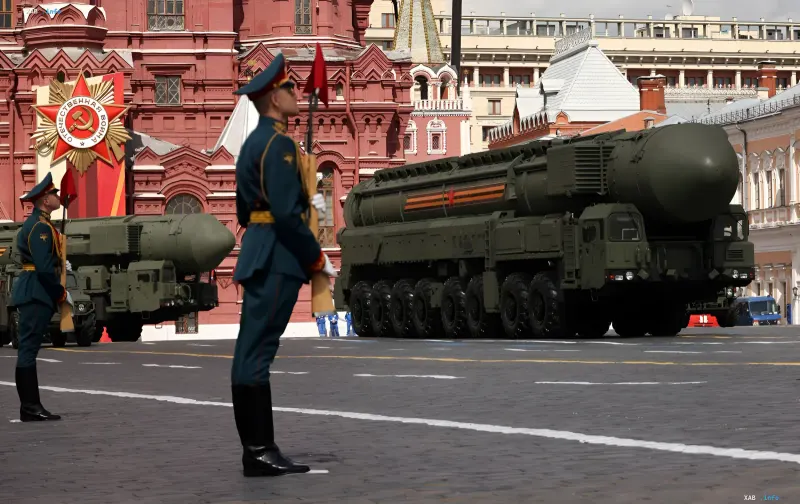
In total, the Russian nuclear arsenal, according to SIPRI's estimate, comprises 5,420 warheads. Of these, 2,604 were in central storage, and a further 1,020 were listed as removed from service. The deployed potential is distributed across the three components of the so-called nuclear triad. Land-based forces can carry up to 1,092 warheads, of which approximately 892 are currently deployed on intercontinental ballistic missiles. The navy operates 13 strategic nuclear submarines with a potential of 928 warheads, however two submarines are undergoing comprehensive repair, so the effectively available number of deployed warheads is estimated at 704. A further roughly 586 warheads, according to the institute, are allocated to strategic bombers.
Strategic Aviation Losses and Dispersal
The report devotes separate attention to losses suffered by Russian strategic aviation in 2025, linked to strikes by the Ukrainian Armed Forces on airbases. Following these incidents, SIPRI assesses that Russian command dispersed some of its strategic aircraft, including Tu-160M and Tu-95MS, to remote airfields. In parallel, Moscow continues to deploy new missile systems, including the "Oreshnik" complexes, some of which, according to the report, are stationed on the territory of Belarus.
Modernization Delays and the Expiry of New START
Despite the rise in the number of deployed warheads, the program to modernize Russia's nuclear forces, experts conclude, is facing delays. Cited reasons include Western sanctions, problems in Russian industry, and the priority given to producing conventional weapons needed for the war against Ukraine. A significant factor increasing the secrecy surrounding the arsenals was the expiration in February 2026 of the Russia–U.S. Treaty on Measures for the Further Reduction and Limitation of Strategic Offensive Arms (New START), which was not extended. For comparison: the United States has deployed about 1,770 warheads, France — 280, the United Kingdom — 120, and China increased its deployed arsenal over the year from 24 to 34 warheads, with a total stockpile of around 620.
Contradictory Data
When checking the figures cited in secondary retellings of the report, an internal inconsistency in the arithmetic of the deployed arsenal emerges. The sum of deployed/available warheads across the three triad components — 892 (land-based) + 704 (navy) + 586 (aviation) — gives 2,182, which markedly exceeds the total deployed-warhead figure of 1,796 stated in the same report. The difference is 386 units. Possible explanations, which are not clarified in the available retellings, include differences in counting methodology (for example, the aviation figure may reflect potential rather than strictly deployed warheads) or overlapping categories. That said, the key conclusion that the deployed arsenal has grown to a nine-year high is confirmed by all verified outlets, so the discrepancy concerns the detail rather than the main fact.
Rhetoric and Warnings
Against the backdrop of the growing arsenal and the absence of a functioning New START, SIPRI warns that the number of operational nuclear warheads may continue to rise, and that the pace of this process could even accelerate in the coming years. In the Russian public sphere, calls to use nuclear weapons against Ukraine have already been voiced: State Duma deputy Alexey Zhuravlev stated that the Kremlin is "obliged" to deliver such a strike if necessary. In August, Turkish Foreign Minister Hakan Fidan suggested that Moscow might resort to nuclear weapons in the event of critical exhaustion at the front and in the rear, noting that during his visit to Russia he heard demands from part of society to use this "last resort" and that he had warned Western partners of this.