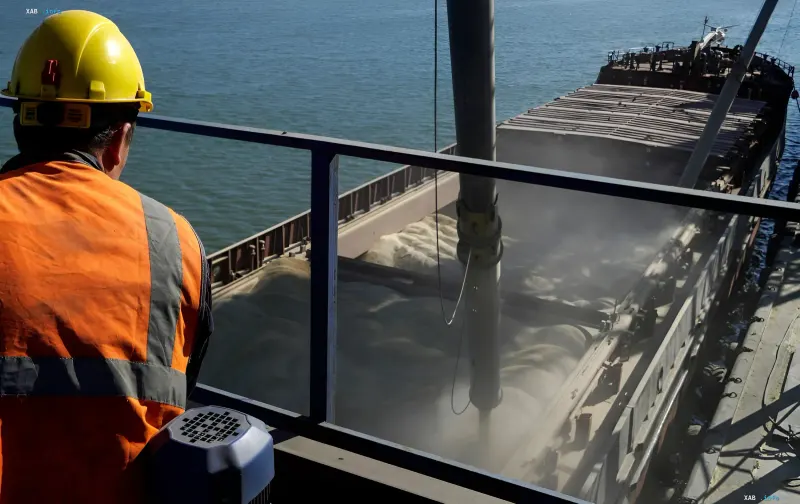
Russian authorities have granted temporary permission for grain vessels to leave ports in the Sea of Azov for the first time since July. According to Bloomberg, the regional port administration issued corresponding departure permits for the ports of Temryuk and Kavkaz. The departure window opened on Monday, allowing crews on site and ready to sail to submit applications for departure. According to the publication, at least one vessel has already successfully passed through the Kerch Strait toward the Black Sea, confirming the actual resumption of shipping in the region.
Economic Context: One-Third of Wheat Exports
The decision to reopen the ports is of significant importance to the global food market. Prior to the escalation and complete halt of shipping on July 10, Azov ports accounted for about a third of Russia's seaborne wheat exports. This means that even a partial resumption of cargo flow can affect global supply and demand balances for grain, especially as alternative logistical routes operate with limited capacity.
Market Reaction: Rapid Decline, but Without Euphoria
Wheat futures on the Chicago exchange reacted to the news with a 2.8% drop, falling to their lowest level since July 1. However, as Bertrand Esterlet, commodity broker and vice president at StoneX, notes, the initial market reaction was a quick downward move, but few traders believe the reopening of the ports will substantially alter the risk outlook. Suppliers and traders emphasize that the situation remains tense and the effect of the decision could prove temporary unless systemic restrictions on shipping are lifted.
Security: An Unresolved Problem
Experts point to a key factor constraining the full recovery of exports: the lack of a ceasefire. Vessels crossing the Black Sea still face the risk of being hit by unmanned aerial vehicles. This means that even a formal departure permit does not guarantee safe passage along the entire route to destinations. Insurance rates and logistical risks remain elevated, dampening the activity of charterers and shipping companies.
Parallel Tracks: Ukraine and the EU Tighten Positions
Against the backdrop of resumed Russian seaborne grain exports, parallel processes are unfolding. In Ukraine, where land export logistics remain vulnerable due to the threat of constant attacks on grain trucks, the possibility of moving customs clearance points inland into Poland and Slovakia is being considered. Corresponding negotiations with neighboring countries are already underway. In the European Union, the issue of restricting Russian agricultural exports is being raised: the Baltic States are demanding a ban on the transit of Russian grain through EU territory, arguing this is necessary to stop financing the aggression against Ukraine.
Thus, Moscow's decision to open Azov ports for grain vessels forms a new round of maneuvering in the global food market, where logistical, military, and political factors continue to intertwine, determining actual export volumes and trading expectations.