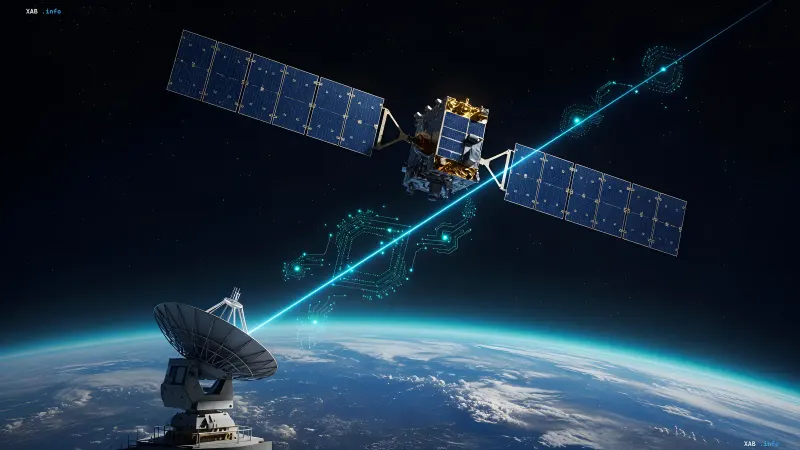
Scientists at the National Research University MISiS, together with colleagues from the Technical University of Braunschweig (Germany) and the company KuSpace Technologies, have developed a new mathematical method for assessing data security in satellite quantum communication. The key distinction of the approach is that it accounts for real differences in the efficiency of photon detectors, which makes it possible to calculate the permissible length of the secret key more than 60 times faster than existing numerical algorithms. The research results have been published in the peer-reviewed journal Entropy.
Physical basis and practical vulnerability
The security of quantum data transmission is fundamentally different from classical cryptography: it relies not on the computational complexity of a problem, but on the laws of quantum physics. Any unauthorized observation of the information carrier inevitably changes its state, which is detected by the legitimate users. In practice, however, the ideal model is disrupted by the imperfections of the equipment. In particular, the differing sensitivity and efficiency of the photon detectors on the receiving side create so-called "side channels" through which a potential attacker can extract additional information about the encryption key. For satellite systems, this problem becomes critical: once the spacecraft is placed in orbit, it is practically impossible to replace or reconfigure the detectors, so the calculation of a safe key length must be performed at the design stage and during each communication session, taking into account the actual characteristics of the equipment.
Mathematical apparatus of the new method
The approach proposed by the researchers is an analytical formula that estimates the volume of potential information leakage and determines how much the original sequence must be shortened to guarantee the secrecy of the key. Unlike previous numerical methods, which required iterative modeling for each specific set of detector parameters, the new formula is applicable even when there is a substantial difference in characteristics between individual receiver channels. This eliminates the main bottleneck of earlier approaches — the computational cost, which grew exponentially with the number of detectors and the degree of their mismatch.
Experimental validation on data from the Micius satellite
The development was tested on real data from a 220-second quantum communication session of the Chinese satellite Micius with the ground station at the Zvenigorod Observatory. Four photon detectors registered approximately 4.96 million signals during the session. From the resulting sequence, the calculation showed that a secret key of 271,670 bits could be generated. These data served as the reference test set for comparing the new analytical method with the traditional numerical algorithm.
Speed and accuracy: under a second versus two minutes
The calculation using the new methodology took less than one second. The numerical algorithm completed the same task in more than 100 seconds and determined a safe key length of 277,100 bits. The difference of 5,430 bits (about 2%) between the results of the two methods is within the expected discrepancy, given that the analytical formula provides a conservative (stricter) estimate, which is preferable for security tasks. Reducing the calculation time from two minutes to a fraction of a second makes it possible to recompute security parameters in real time during each satellite communication session, rather than only at the preliminary modeling stage.
Significance for the development of quantum networks
The work was carried out with the support of the Russian Science Foundation. Publication in the journal Entropy, which specializes in issues of information, entropy, and their applications, confirms that the method has undergone independent peer review. The developed formula can be integrated into the onboard and ground software of satellite quantum systems, ensuring automatic recalculation of the key length based on the current detector characteristics. This lowers the entry barrier for operators of quantum networks, who no longer need computational infrastructure for numerical modeling, and increases the resilience of satellite channels to hardware degradation in orbit.