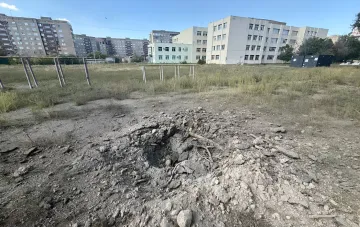
On September 22, a Russian artillery shell struck the building of one of Oshadbank's branches in Kherson, causing significant damage. This was reported by the financial institution itself in its official Telegram channel, and the information was confirmed by RBC-Ukraine, Interfax-Ukraine, and a number of other Ukrainian media outlets. According to the bank, thanks to the branch's operations having been relocated in advance to a safer location, no employees were injured: people, property, and bank valuables were evacuated before the strike.
Timeline of the incident and the bank management's response
Oshadbank Chairman Yuri Katsion, in an address to customers and employees, emphasized that the priority in the bank's work is the life and health of people. "Changes in the operation of branches or their temporary closure are forced steps taken solely for the safety of people," he stated. According to the statement, the institution's employees continue to provide services to customers, but already at a different, safe location. Thus, the physical destruction of the building did not lead to a complete halt of service in the area.
Continuity infrastructure: mobile units and POWER BANKING
Oshadbank emphasizes that the financial institution ensures service continuity through several mechanisms. In particular, mobile banking units are operating — 15 car-based branches that can be quickly relocated to customers in the event of damage to fixed locations. In total, the bank has maintained one of the largest banking networks in the country — 1,150 branches, of which 460 are part of the POWER BANKING system, equipped with autonomous power supply and backup communications. This allows branches to function even during power outages and damaged telecommunications infrastructure. In addition, most banking transactions can be carried out by customers remotely through the bank's online services.
Context: a series of incidents involving electronic services
The strike on the building in Kherson is not an isolated event. On September 17, Oshadbank warned customers about disruptions in its electronic services caused by Russian shelling. Even earlier, on August 25, a failure occurred in the bank's app, accompanied by partial restrictions on access to electronic services; the cause at that time was cited as the triggering of security systems. The series of incidents over the past two months indicates systematic pressure on Ukraine's banking infrastructure and demonstrates how the physical destruction of facilities and cyber threats are combined in a single campaign.
Contradictory data
No significant discrepancies in the facts were found in the provided sources: all four publications (RBC-Ukraine, from-ua.org, Interfax-Ukraine, ua.news) unanimously report the shell impact, significant damage to the building, and the absence of casualties. The differences concern only the wording: some sources use the term "artillery shell," while others use the more general "shelling." The exact type of munition and the direction of the shelling are not disclosed in the bank's public statements, leaving room for further clarification by military structures.