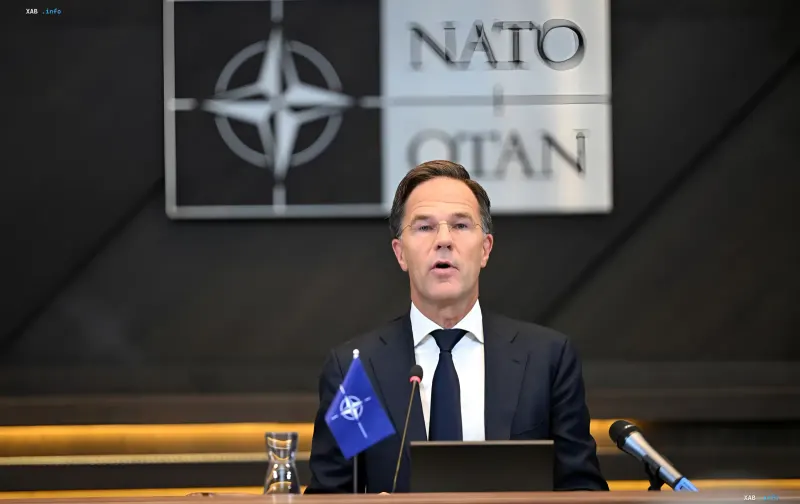
NATO Secretary General Mark Rutte has stated that creating a single European armed force that operates in parallel with the Alliance and national armies could be significantly detrimental in the event of a Russian attack due to delays in decision-making. He stated this during his speech at the 72nd annual session of the NATO Parliamentary Assembly in Berlin, RBC-Ukraine reports. According to the head of the Alliance, the very idea of a European army does not suit him in the form it is often discussed—the fear is specifically about the duplication of structures.
“If there are European forces, there cannot be national ones”
Rutte emphasized that he is not opposed to the concept of a single European armed force, but added: if such a structure were to be created, it should replace the national armies of EU countries, not exist alongside them. He cited the United States as an example, where a single armed forces system operates. “My position has always been that if you have European armed forces, you cannot have national armed forces. The US has a single armed force. There is no separate army or navy for the state of New York, or for the state of California. These are the only integrated armed forces. If Europe can achieve that, great,” the Secretary General said.
The attack scenario: “Putin would likely be in Rotterdam”
Explaining his position, Rutte cited a hypothetical scenario of a Russian attack on European countries. According to him, the existence of parallel structures—national armies, NATO, and a separate European force—would complicate coordination and delay decision-making by two to three weeks. “Because if Putin attacks, we would first need two to three weeks to agree on who does what, and by then, he would likely already be in Rotterdam before we make a decision,” the NATO Secretary General said. It is this risk, by his estimation, that makes the duplication of functions dangerous for collective defense.
Doubts on implementation and warning against parallel structures
At the same time, the head of the Alliance expressed doubt that such an integrated format could be implemented anytime soon. He explicitly warned against a model where all national armed forces would cooperate within NATO while simultaneously creating another large European structure. According to him, it is precisely this accumulation, rather than the idea of a European army itself, that could paralyze the Alliance's response in a crisis situation.
Context: “unacceptable” Russian calls and strengthening the eastern flank
Earlier, Rutte stated that Russia's calls to return to the European security system that existed before 1997 are “unacceptable.” Against the backdrop of these statements, the Polish Ministry of Defense emphasized that NATO must strengthen the country's air defense and the entire eastern flank of the Alliance after Russian missiles violated Polish airspace. Additional context was provided by the Secretary General's speech on the sidelines of the Euronews Defence & Space Summit 2026 in Brussels on September 30, where he stated that Russia is losing the war against Ukraine and linked this to increased nuclear threats and sabotage in Europe, calling on allies to remain calm and continue investments in supporting Kyiv, primarily in the field of air defense.