Informational Collapse: How a Coincidence of Names Led to Disinformation
On August 15, 2026, a massive glitch occurred in the information space related to an attack on Defense Industry Complex (DIC) facilities. In the first hours after the incident, news aggregators and social networks spread contradictory data: some sources reported a strike on the Cheboksary branch of JSC 'VNIIR-Progress', while specialized monitoring channels and officials pointed to the strike on the Rocket and Space Center JSC 'RSC 'Progress'' in Samara. This case demonstrates the vulnerability of the media space to disorientation caused by the coincidence of keywords in the names of strategic enterprises.
The main factor of confusion was that both enterprises, despite different specializations and jurisdictions, have the word 'Progress' in their names. In conditions of a shortage of operational verification and high information noise, aggregator algorithms erroneously combined reports of previous incidents in Chuvashia with new data from the Samara region. Both plants indeed produce critically important components for the aerospace industry, which exacerbated the situation and led to false conclusions about the scale of the strike.
Legal and Production Identification: Samara vs. Cheboksary
To correctly assess the situation, a clear distinction must be made between two legal entities. JSC 'RSC 'Progress'' (Samara) is part of the state corporation 'Roscosmos' and is located at Zemetsa St., 18. The specialization of the enterprise is focused on the production of 'Soyuz-2' launch vehicles of various modifications, as well as spacecraft of the 'Resurs-P', 'Bars-M', and 'Bion-M' series. Critical nomenclature includes onboard rocket control systems, fuselage assembly, and electrical installation in clean zones.
In turn, JSC 'VNIIR-Progress' (Cheboksary) is part of the 'ABS Electro' group of companies and is based at Yakovlev Ave., 4. The enterprise profile is radio electronics, marine electrotechnics, relay protection, and automation. The key product is adaptive anti-jamming antenna arrays CRPA of the 'Comet' / 'Comet-M' series. Despite the similarity of names, these enterprises belong to completely different technological echelons and are located in different subjects of the Federation, which is critical for geopolitical analysis.
Contradictory Data: Verification via Satellite Monitoring
In the first hours after the incident, there were two competing versions of events. The first version, circulating in a number of Telegram channels, claimed an attack on an object in Cheboksary. However, verification of geospatial data and official statements refuted this hypothesis. On the specified date, no alarm signals, airport airspace closures, or fire foci were recorded on the territory of JSC 'VNIIR-Progress' in Cheboksary.
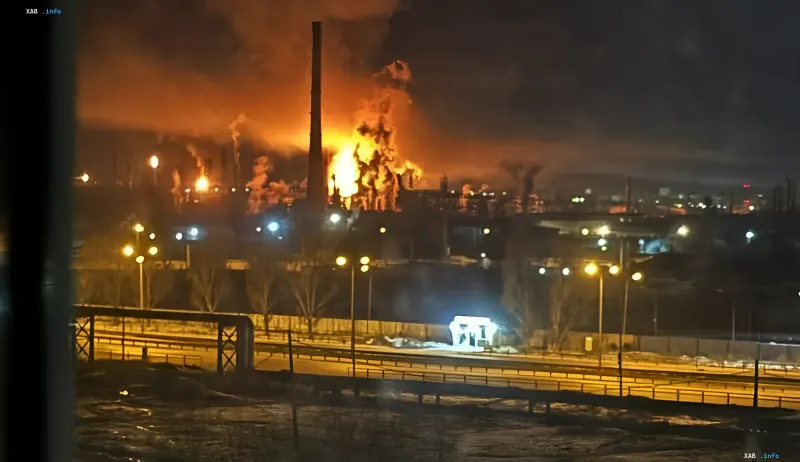
The second version, confirmed by the Ukrainian side and OSINT data, points to the strike on an object specifically in the Samara region. The Ukrainian General Staff officially confirmed the conduct of a long-range operation against the Samara rocket cluster, noting the strike on production lines for space launch vehicles. Satellite monitoring data (NASA FIRMS) and eyewitness photos recorded thermal spots and smoke in the industrial sector of Bezymianka in Samara, specifically in the area of building 106A of JSC 'RSC 'Progress''.
Fact-checking Methodology in Conditions of Hybrid Warfare
This incident highlights the need to apply strict verification algorithms when working with military reports. The basic tool is verification against state registers of legal entities (EGRUL), which allows clarifying the full name of the company, registration address, and types of economic activity (OKVED). This helps avoid confusion between branches and similarly named productions.
The second critical stage is cross-verification via satellite thermal monitoring systems. Comparing the coordinates of the claimed object with archives of thermal anomalies in real-time allows confirming or refuting the presence of a fire. The third stage is video material geolocation, including tying the contours of industrial buildings, TPP pipes, and road junctions to open cartographic services. Only a comprehensive approach allows filtering out disinformation and establishing the factual picture of events.
Macroeconomic and Strategic Consequences
The strike on JSC 'RSC 'Progress'' in Samara has serious long-term consequences for the Russian space program. Damage to 'Soyuz-2' launch vehicle production lines may lead to a disruption of the launch schedule and a shortage of launch vehicles in the domestic and international markets. This, in turn, may affect the fulfillment of state contracts and Roscosmos' export obligations.
On the other hand, the preservation of the operability of JSC 'VNIIR-Progress' in Cheboksary means that the production of critically important antenna arrays for EW systems was not disrupted. This is important for understanding the strategic priorities of the attack: the strike was delivered specifically against rocket building, not radio electronics. Distinguishing these objects allows for a more accurate assessment of the scale of damage and forecasting further steps within the framework of the conflict.