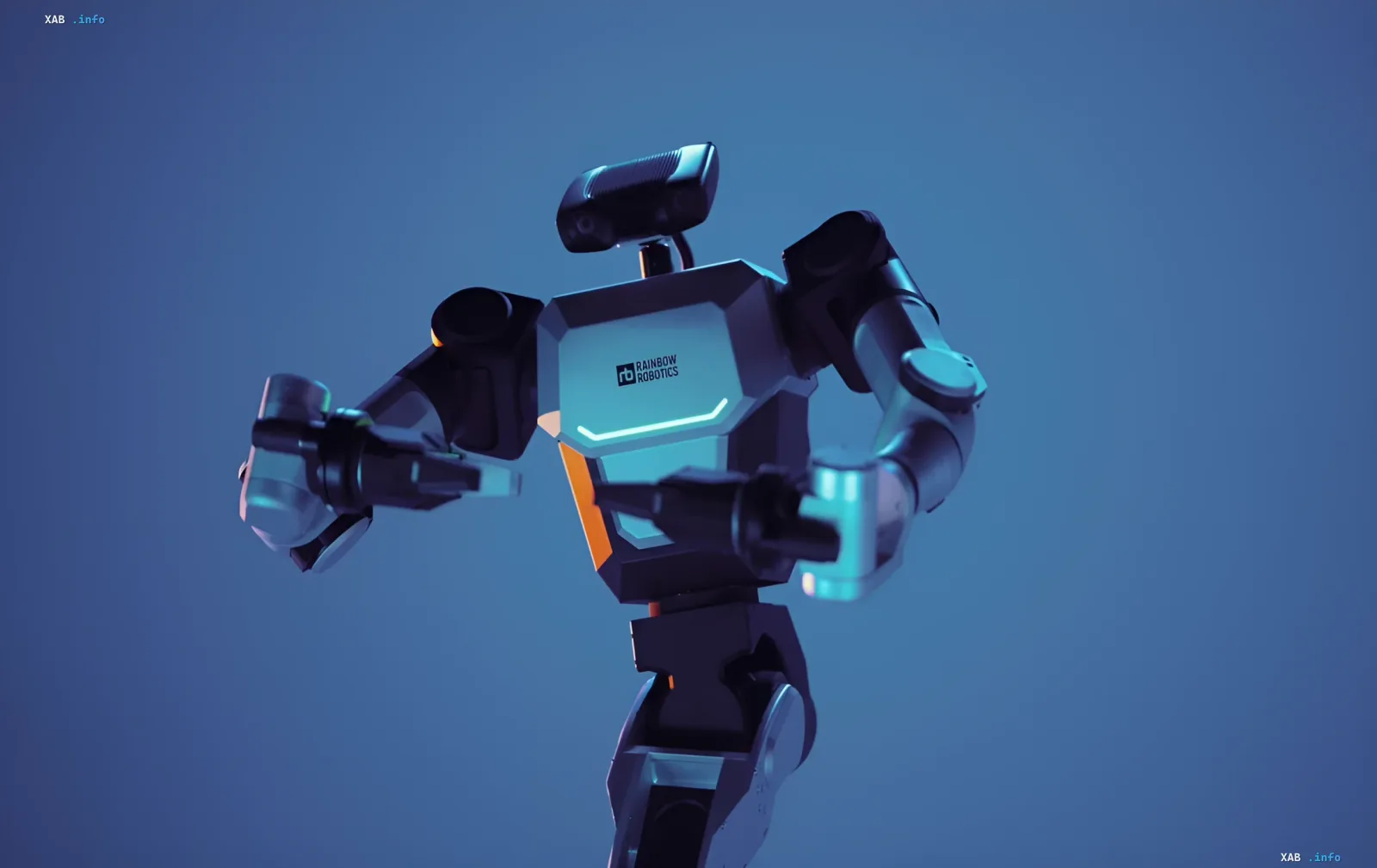
A significant event has occurred in the world of robotics that could become a turning point for the logistics of the future. The RB-Y1 humanoid robot, developed by Rainbow Robotics, a company controlled by Samsung, has begun its first real-world trials at a commercial facility. The android was spotted inside a Coupang fulfillment center — the largest e-commerce operator in South Korea.
This information was reported by RBK-Ukraine, citing the publication Interesting Engineering. The appearance of the robot on a real warehouse floor, rather than in a laboratory setting, signals a transition from theoretical development to practical implementation.
Pragmatic design instead of classic bipedal locomotion
Unlike most modern humanoid robots that move on two legs, the engineers behind RB-Y1 chose a more pragmatic design. The machine combines a high-speed wheeled platform with an upper body featuring two arms that fully replicate the movements of a human torso.
This approach avoids the stability issues inherent to bipedal robots and significantly increases the speed of movement within warehouse facilities.
Technical specifications and capabilities
The dimensions and capabilities of RB-Y1 are optimized for warehouse conditions:
- The robot is approximately 1.4 meters tall and weighs 131 kilograms.
- Each of the two mechanical arms has seven degrees of freedom and can lift loads weighing up to 3 kilograms.
- Thanks to its high-speed wheeled base, the robot can move at speeds of up to 1.5 meters per second.
To ensure stability during sharp turns or while carrying boxes, the manufacturer integrated a 20-axis whole-body control system. Additionally, proprietary software has been developed to prevent the arms from colliding with each other, which is critical when working in confined spaces.
Samsung's strategic ambitions
The appearance of the robot at the Coupang warehouse is not just a test launch, but part of a massive strategy by the tech giant. Recently, Samsung increased its stake in Rainbow Robotics to 35 percent, turning it into a subsidiary.
Samsung has officially identified this direction as one of the key vectors for long-term growth, alongside the development of artificial intelligence and advanced semiconductors. The company is betting that robotics will become an economic driver just as significant as chips.
South Korea as a global leader in automation
The implementation of such technologies in South Korea is not accidental. The country currently remains the world leader in the level of production automation. According to the International Federation of Robotics, the country has the highest robot density in the world: approximately 1,012 industrial units for every 10,000 workers.
This figure is more than seven times higher than the global average. The successful completion of the pilot project at Coupang warehouses could send a clear signal to the entire global industry that complex mobile manipulators are ready for full-scale commercial operation.


