
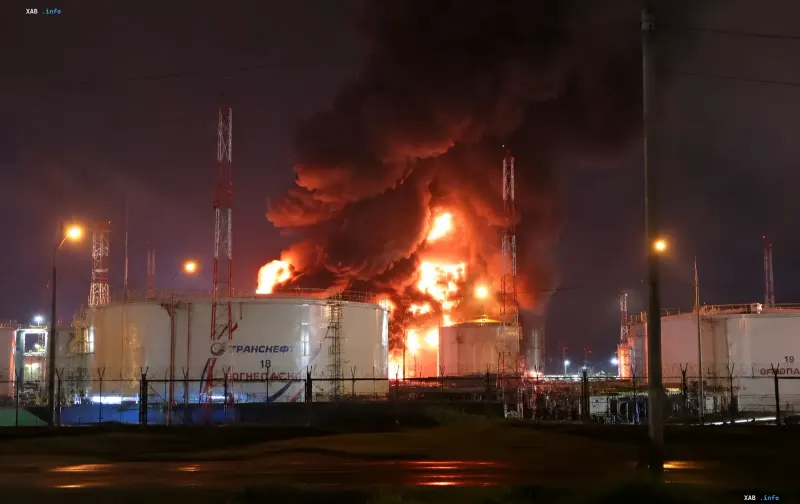
On July 8, the Security Service of Ukraine (SBU) carried out a large-scale operation on Russian territory, striking one of the strategically important fuel logistics facilities. The target of the attack was the Cherkassy Linear Production and Dispatch Station (LPDS), located in the Republic of Bashkortostan. According to the intelligence agency, the operation was successfully executed, resulting in a fire at the station.
Operation details and scale of the attack
The SBU revealed details of the operation, emphasizing the complexity and distance of the route. The facility is located approximately 1,500 kilometers from the Ukrainian state border, making its attack a challenging task. According to the agency, the station was hit by at least eight strikes using unmanned aerial vehicles.
As a result of the attack, a powerful fire broke out at the LPDS. The fire engulfed the tank farm and the production facilities of the station. Visual evidence confirms the scale of the fire: columns of fire and thick smoke are visible from a significant distance.
Strategic importance of the facility
The Cherkassy LPDS is one of the key nodes of the Transneft-Ural system. The station plays a critical role in the supply chain: it handles the receipt, accumulation, storage, and subsequent transportation of light oil products. It is here that fuel from the Ufa oil refining hub is directed into the main oil product pipelines.
The scale of the station's activities is confirmed by the figures:
- The annual volume of pumping through the facility is about 2 million tons of oil products.
- The tank farm consists of 27 tanks.
- The total storage volume exceeds 385 thousand cubic meters.
Consequences for Russian logistics
An attack on such a large hub significantly complicates the supply of oil products to the central and eastern regions of Russia. The disruption of the LPDS negatively affects the overall efficiency of the country's fuel logistics, creating risks of shortages and disruptions in resource distribution.
The SBU stated that such operations demonstrate the agency's ability to operate throughout the territory of Russia. "For the occupier, there are no longer any safe regions, even in the deep rear," the agency noted.
Context of ongoing attacks
The operation in Bashkortostan is not an isolated case. Previously, Ukrainian forces struck a wide range of Russian targets, including airbases, ports in Crimea, airfields, and bridges. Russian oil refineries and tankers were also in the zone of impact.
Particular attention is paid to attacks on Russia's "shadow fleet." SBU fighters successfully attacked another 9 tankers used to bypass sanctions and transport oil. These actions are aimed at undermining the economic base financing military operations.


