
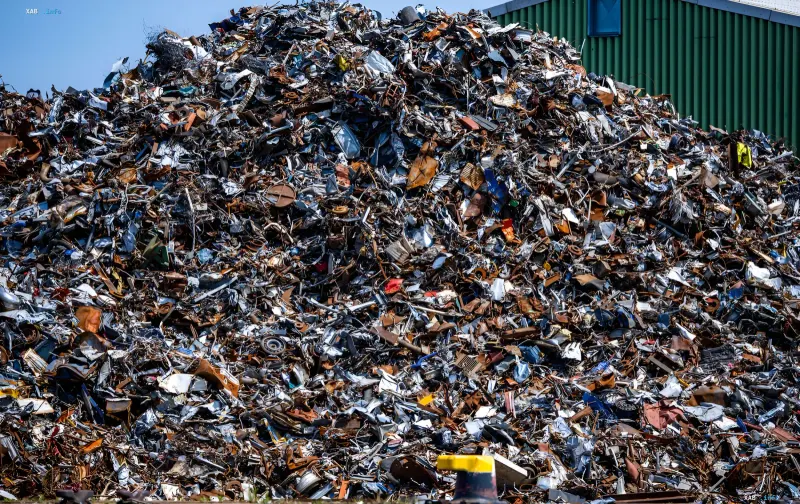
Oleksandr Kalenkov, President of the Ukrmetalurgprom Association of Enterprises, has demanded the establishment of a minimum starting price of 80 euros per ton within the auction mechanism for scrap metal export quotas. According to him, without a fixed lower limit, the state risks losing strategic raw materials without receiving any budgetary effect from their export. The statement was made in the context of discussing proposals from the Ministry of Economy of Ukraine on holding open electronic bidding for the right to export scrap.
Absence of a starting price as the main systemic risk
Kalenkov acknowledged that the principle of open bidding itself is correct and necessary for market transparency. However, in his estimation, the mechanism proposed by the Ministry of Economy lacks a clearly established starting price, which creates, in his wording, the main risk. "If the state opens the export of strategic raw materials, it must immediately determine the rules by which this export will generate income not only for traders, but also for the budget. A starting price of 80 euros per ton should be set at the governmental level rather than remain a subject of manipulation and backroom deals," he stated. Thus, it is not a question of banning exports, but of securing the economic parameters of the bidding before they begin.
Budget calculations: 16 million euros versus 22.6 million in traders' super-profits
According to Ukrmetalurgprom's calculations, with a quota of 200,000 tons, a starting price of 80 euros per ton can provide the state budget with an income of about 16 million euros. At the same time, export remains profitable for traders as well, since the market value of scrap exceeds the proposed minimum. In the opposite scenario—with a zero starting price—the potential super-profit of exporters could reach 22.6 million euros, while the budget will not receive a single euro from the sale of scarce raw materials. Kalenkov directly raised the question of whose side the Ministry of Economy is on in this situation—the state and the budget, or the scrap traders—and emphasized that the rules must be formulated to exclude any double interpretations.
Strategic raw material and domestic market priority
Kalenkov placed special emphasis on the status of scrap metal as a strategic raw material for Ukrainian metallurgy. He claimed that maximum volumes of scrap belonging to state-owned companies, particularly Ukrzaliznytsia, should remain on the domestic market. After the full resumption of operations, metallurgical enterprises, according to Ukrmetalurgprom, are ready to buy 90–95% of the raw material from suppliers. Kalenkov also spoke out against introducing any separate rules for state-owned companies, arguing that exceptions for individual participants create fertile ground for schemes, unequal competition, and additional budget losses.
Positions of other market participants and parameters of the Ministry of Economy's proposal
Earlier, the European Business Association urged authorities to maintain a zero quota for scrap metal exports until an effective export duty mechanism for all countries without exception is created in Ukraine. The association emphasizes that under wartime conditions, scrap should not be viewed simply as an export commodity, but as a strategic raw material for domestic metallurgy. The Ministry of Economy, in turn, stipulates a starting price of 27 euros per ton—significantly lower than the level proposed by Ukrmetalurgprom. Department head Andriy Zhablovsky previously stated that the sale of scrap metal should take place exclusively through open electronic auctions, and the rules should be the same for all market participants. Thus, three different positions have formed on the market: a complete export ban until a duty mechanism is created, auctions with a starting price of 27 euros, and auctions with a starting price of 80 euros.
Context: why the issue has become acute right now
The discussion of the parameters of the export mechanism for scrap is taking place against the backdrop of the metallurgical sector's recovery following the period of hostilities and the need to supply plants with raw materials for the full launch of production lines. The divergence in starting price figures—27 euros versus 80 euros—means a difference in the potential budgetary effect measured in tens of millions of euros on the scale of the annual quota. The final decision on the auction parameters, according to available data, has not yet been made at the governmental level, and the discussion between industry associations and the relevant ministry continues.


