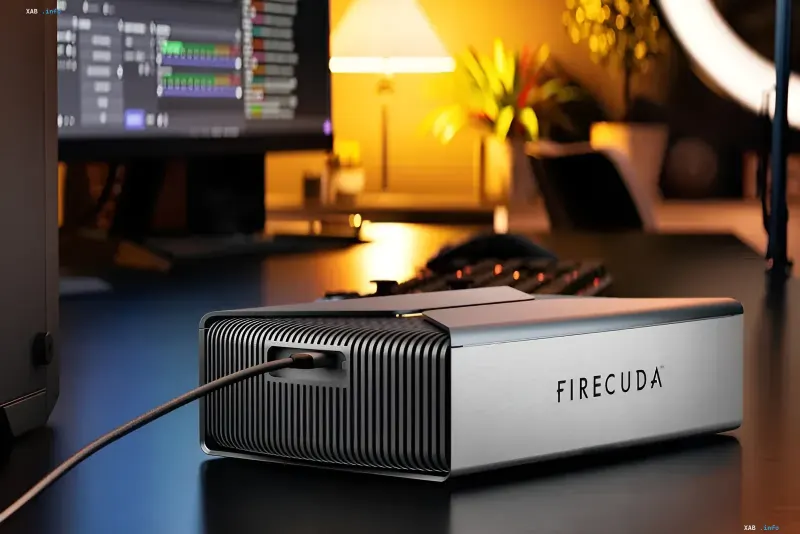
Seagate has launched the FireCuda Forge, a new external storage device positioned as a hybrid of the high speed of solid-state drives and the affordable capacity of hard disk drives. The new product is the first to use the Seagate Alkemi intelligent platform, which uses machine learning algorithms to analyze data usage patterns and automatically move the most demanded files to the fast SSD sector. For the operating system, the entire setup appears as a single logical drive, eliminating the need for the user to manually manage data distribution between the two types of memory.
Alkemi Architecture and Operation Principle
The idea of combining an HDD and flash memory in a single enclosure is not new: Seagate has been manufacturing hybrid drives for decades. However, the FireCuda Forge differs fundamentally from previous generations in that the user independently chooses which hard disk and solid-state module to install in the enclosure. In format, this resembles the principle of network-attached storage (NAS), where an SSD is used to cache frequently accessed data, but Seagate emphasizes that the FireCuda Forge functions differently: the Alkemi platform dynamically redistributes data between the two drives depending on the current workload, and as the user's tasks change, files "migrate" between disks without human intervention.
Configurations and Component Requirements
The FireCuda Forge is available in two versions: with an 8 TB hard disk and a 20 TB hard disk. In both configurations, the HDD is replaceable, allowing the owner to subsequently increase the total storage capacity without buying a new device. The SSD module is not included and is installed by the user independently. Seagate sets specific requirements for it: M.2 2280 form factor, PCIe 3.0 support or higher, sequential read speed of at least 2400 MB/s, write speed of at least 2000 MB/s, and a capacity of up to 1 TB. For optimal performance, it is recommended to use an SSD with its own DRAM cache.
Performance, Interfaces, and Application Scenarios
According to the manufacturer, the FireCuda Forge is capable of achieving sequential read speeds of up to 2500 MB/s and write speeds of up to 2000 MB/s. The external drive connects to a computer via a USB4 interface and is compatible with Windows 11 and macOS 26 and later versions. The device is equipped with programmable RGB lighting, indicating its orientation toward the gaming and creative audience. Seagate explicitly names target scenarios: gaming, streaming, video recording, editing, and media export.
Pricing and Availability
The FireCuda Forge drive is now on sale in the Seagate online store. The version with an 8 TB hard disk is priced at $699, while the 20 TB model costs $899. However, it is important to consider that the NVMe SSD is not included in the package, and given the current shortage of solid-state drives on the market, the final cost of a ready-to-use device may significantly exceed the stated price of the enclosure. The buyer will have to separately purchase a suitable module, which in conditions of limited supply can add from several tens to hundreds of dollars to the budget depending on the chosen model.
Context and Market Position
The appearance of the FireCuda Forge in late 2026—against the backdrop of steadily rising NAND flash prices and a shortage of high-capacity SSDs—looks like Seagate's strategic response to the demand from an audience that needs large capacity without compromising speed for working tasks. The Alkemi platform with machine learning for data management distinguishes the product from simple "SSD caches" in NAS solutions and from previous-generation hybrid HDDs where caching was static. If the technology proves itself in real editing and streaming scenarios, the FireCuda Forge could become a new standard for mid-to-high-tier external hybrid drives.