Ancient Ukrainian wedding rituals are a complex system of symbols designed to facilitate a harmonious transition of a young woman into a new family. A central figure in these rituals was the mother-in-law, who acted not only as the head of the household but as a sacred mediator between two clans. Research by ethnographers such as Svitlana Boian-Hladka and Khrystyna Terletska confirms that every action, whether offering bread or wrapping in fur, carried a deep magical subtext.
Bread Rituals and the Protective Role of the Sheepskin
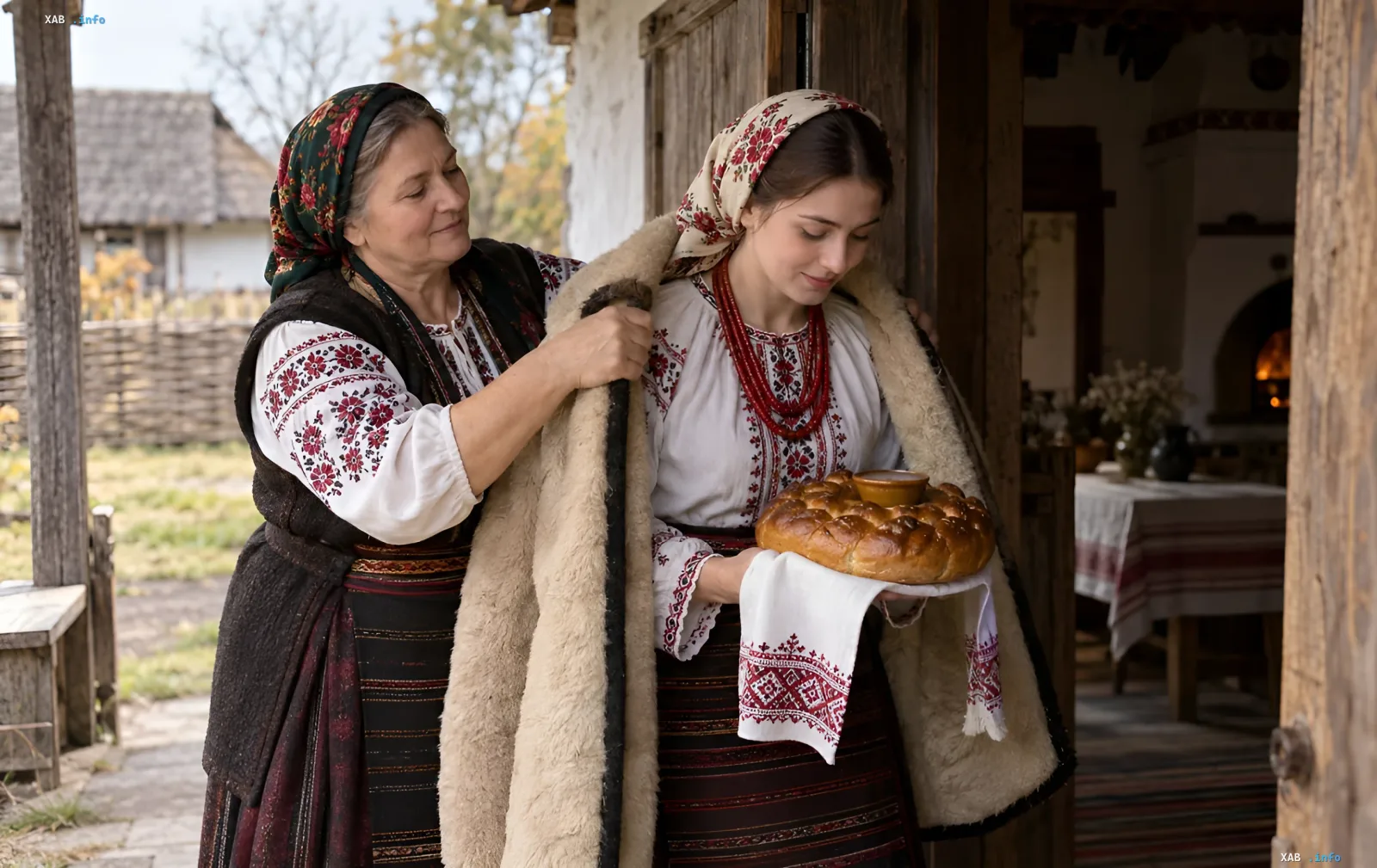
In the Hutsul region, meeting the daughter-in-law was accompanied by offering kalach bread with honey and sprinkling her with grain, symbolizing wishes for prosperity and fertility. In the Boyko region, there was a custom of placing two loaves of bread on the young woman's head so that she would be "as healthy as a cherry." Special attention was paid to the sheepskin coat; turning it inside out served as a powerful amulet. The Lemkos believed the wool warded off evil spirits, while the Boykos associated the fluffy fur with the future wealth of the home.
Symbolism of Status Change
The transition of a girl from her parents' home to her husband's was marked by a change in headwear. In the Podillia region, a rite existed where the mother-in-law covered the daughter-in-law's head with a sheepskin, symbolically "hiding" her from her former life, before removing her wreath and tying a headscarf. This was the moment of final acceptance into the husband's kin, where the woman took on new household duties. A vital element of cementing this union was the mutual exchange of gifts: embroidered towels, kerchiefs, and bread confirmed respect and the strength of family ties.
Contradictory Data: Fairy Tale or Harsh Reality?
There is a debate regarding the nature of the relationship between mother-in-law and daughter-in-law in folklore. Ethnographic studies reveal a duality: on one hand, wedding songs are filled with good wishes; on the other, proverbs like "the daughter-in-law is an outsider bone" reflect a serious conflict of interest. Songs often emphasize distance: a mother allows her daughter to rest, while a mother-in-law demands unquestioning labor, turning the daughter-in-law into a subordinate worker in the new home.
Expert Assessment and Conclusions
Modern ethnographers emphasize that the harshness of folk songs should not be taken as a direct description of every family, but rather as a reflection of the social structure of the time. In modern conditions, these rituals have transformed into beautiful theatrical traditions, preserving the memory of roots while losing their original everyday drama. Understanding these symbols allows for a deeper appreciation of the cultural code of the Ukrainian people and the evolution of family values over the centuries.