
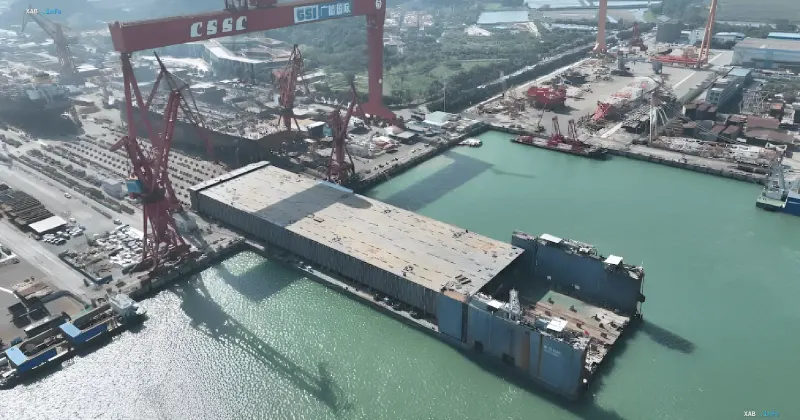
The Shenzhen–Zhongshan Link, officially opened on 30 June 2024 and placed into trial operation, remains one of the largest marine transport projects in the world. The total route length is approximately 24 kilometers and includes bridge spans, artificial islands, and an underwater tunnel. After more than two years of operation, the route demonstrates its main practical value: travel time between the two cities has been cut from roughly two hours to 30 minutes, making the link a key transport artery connecting southern China.
Underwater Tunnel: 6.8 km of Reinforced Concrete on the Seabed
The most technically complex and labor-intensive section of the entire project is the 6.8-kilometer underwater tunnel. Its uniqueness lies in the fact that it is the first case in the world of large-scale application of reinforced concrete structures in an underwater tunnel. Each standard segment of the structure is 165 meters long, 46 meters wide, and 10.6 meters high; after the concrete is poured, the mass of a single segment reaches approximately 80,000 tons. The Fourth Marine Engineering Bureau of the China State Construction Engineering Corporation (CSCEC) took an active part in the project and, according to the contractor, successfully solved the engineering challenges associated with the exceptionally long eight-lane two-way reinforced concrete tunnel.
"Every Compartment Is the First": A Quality Philosophy for 100 Years
The tunnel system comprises 32 segments and one end connection. Of these, 23 segments and the end connection were manufactured by the Fourth Marine Engineering Bureau, while the remaining segments were built by other contractors. About 10,000 tons of steel were used to fabricate each segment, and after concreting its weight reached 80,000 tons. The manufacturing quality of each segment is considered the decisive factor ensuring the stated design service life of the structure — up to 100 years. The project head at the bureau, engineer Qiong Wang San, who had previously taken part in building the underwater tunnel of the Hong Kong–Zhuhai–Macau Bridge, noted that the team inherited the experience of the earlier project but raised the standards to a new level, adhering to the philosophy that "every compartment is the first" in order to guarantee the absolute precision of concreting all 2,255 compartments in each standard segment.
Intelligent Technologies Against Millimeter Deviations
Before being transported to the sea, the "giant concrete blocks" undergo numerous relocations both inside the factory and on the construction site. According to the engineers, even a deviation of around 1 mm during transport could lead to deformation or damage to the structure and affect the quality and service life of the entire project. To solve this problem, the construction team independently developed a range of specialized technologies and equipment: self-compacting concrete with high volumetric stability, the world's largest intelligent vehicle transport system, China's first intelligent concrete-pouring equipment, and a specialized vessel for foundation treatment, the "Sihan Guzi." These solutions make it possible to simultaneously ensure the rapid transport of segments weighing up to 80,000 tons and concrete quality meeting the requirements of 100-year operation.
Millimeter-Level Precision and World Records
Once fabrication is complete, the segments are towed to the installation site by a specialized vessel equipped with an autopilot system capable of turning 180 degrees and maneuvering precisely in narrow shipping channels thanks to Beidou positioning technology. Upon arrival, a measurement and sensor system continuously determines the position, depth, and orientation of the segment to control the winch cable and lower it onto the seabed. The connection technology under seawater pressure ensures the airtightness and complete watertightness of the joints. According to the construction crew, all tunnel segments were installed with an error of less than 5 cm, and millimeter-level precision was achieved on seven consecutive segments. The combination of these indicators, together with the records set during the construction of the road across the sea between Shenzhen and Zhongshan, cements the project's status as one of the most impressive marine transport achievements of the modern era.