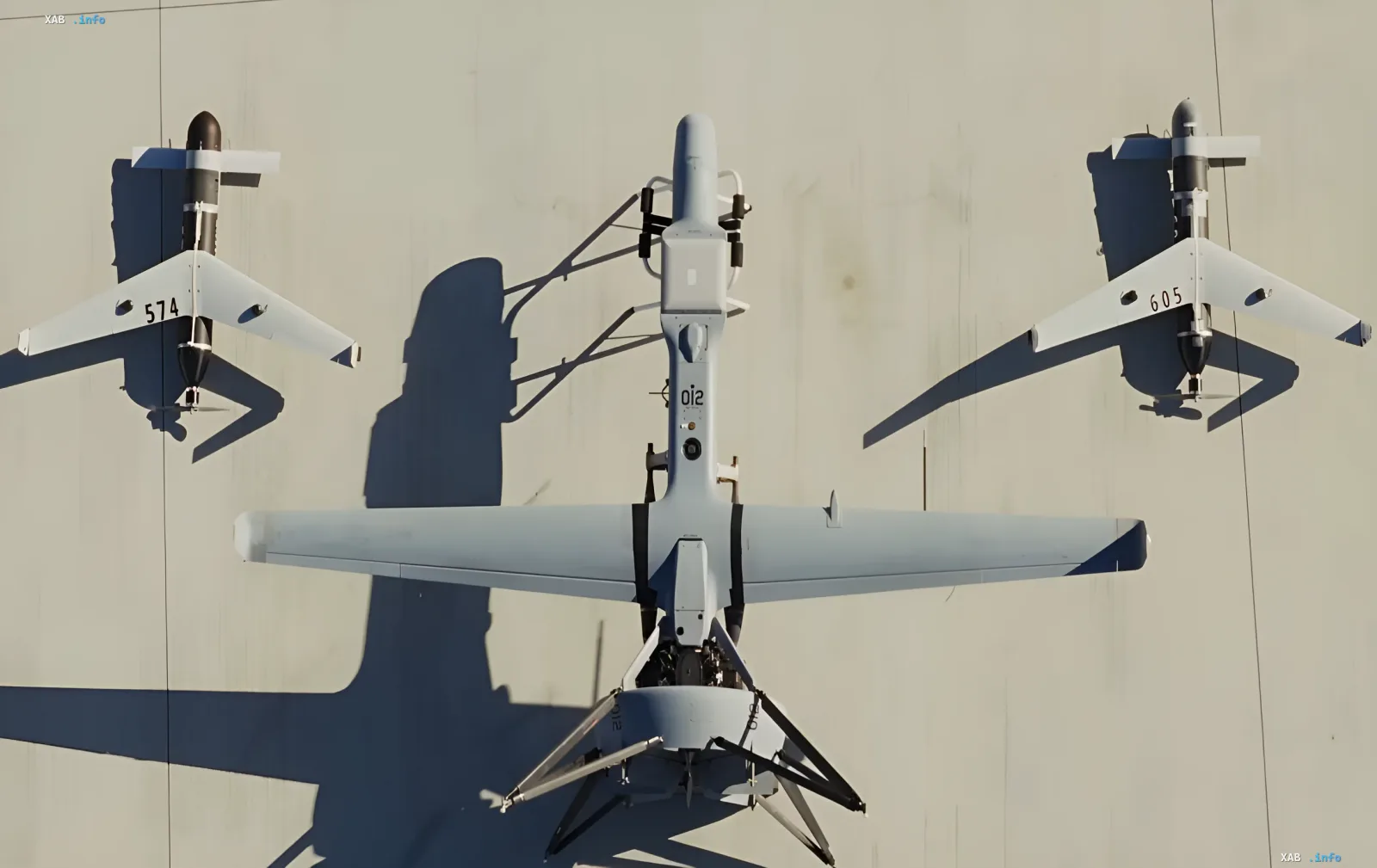
Shield AI, a company specializing in the development of autonomous systems for the US military, has announced a breakthrough in military robotics. Their proprietary Hivemind artificial intelligence has, for the first time, fully autonomously coordinated the joint flight of drones with completely different architectures, creating a single 'smart' combat swarm.
Technology for conditions of total isolation
The main value of the Hivemind system lies in its ability to function as an onboard 'virtual pilot' in the most complex conditions. The AI is specifically designed for missions in areas where GPS is completely blocked and active communication jamming is taking place (EW conditions).
The system does not wait for commands from an operator. It makes decisions in real-time, analyzing data from its own sensors, pre-loaded mission parameters, and the behavior of other aircraft in the group.
Tests in Oklahoma: A meeting of two worlds
During recent tests held in Oklahoma, the AI controlled a team of two radically different drones:
- V-BAT (by Shield AI) — a vertical take-off and landing (VTOL) aircraft. It is launched from a special tube container without the need for a runway or catapult and is capable of hovering over a target for hours.
- Hornet (by Destinus Defence) — fast and maneuverable attack drones of Swiss-Spanish manufacture, designed for rapid strikes in hostile airspace.
The role of the airborne communication node
During the test, the drones performed clearly distributed roles. The large V-BAT drone ascended to altitude and functioned not as a reconnaissance unit, but as an airborne communication node. It created a stable 'mesh' network around itself, connecting the ground control station and the fast Hornet drones.
Thanks to this, even when simulated enemy EW attempted to jam the direct signal from the ground to the Hornet attackers, the AI on board the V-BAT instantly retransmitted updated combat tasks and coordinates to other drones within range.
Autonomous decision-making
Before launch, only a general mission plan was loaded into the system. However, during the flight, the Hivemind AI received dynamic input data. It independently recalculated flight trajectories, changed aircraft courses, and redistributed targets between drones directly in the air without any human intervention.
The modern military arsenal of any country is usually a collection of equipment from different manufacturers, where software and radios are often incompatible. The tests in Oklahoma proved that the Hivemind AI is capable of effectively managing even those drones for which it was not originally created.
The end of the 'one operator — one drone' era
Developers summarize: 'When such technology becomes a mass standard, the classic ratio of 'one operator — one drone' will disappear forever. One soldier will be able to assign tasks to an entire fleet of autonomous machines, and the AI ecosystem itself will decide exactly how to carry out the order in the fiery sky'.


