
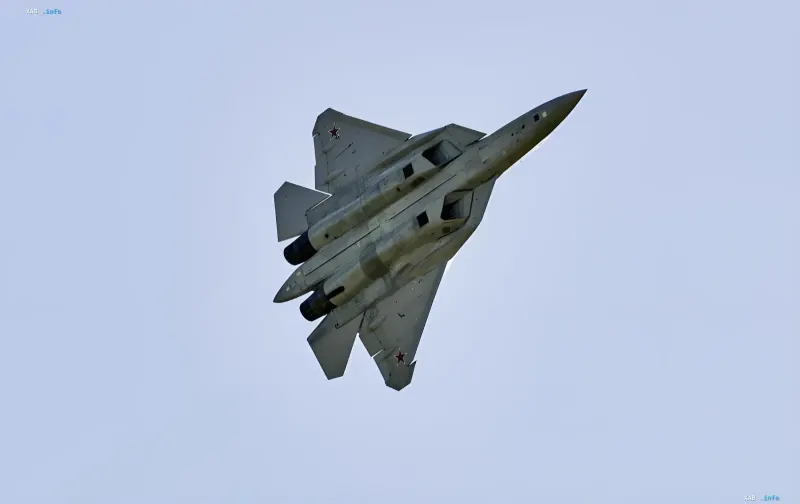
In the Far East, in the city of Komsomolsk-on-Amur, large-scale construction work has been launched to protect key objects of Russian military aviation. Satellite imagery records the active construction of reinforced shelters on the territory of the only plant in the country producing fifth and fourth++ generation fighters — Su-57 and Su-35 — as well as at the neighboring Dzemgi airbase.
Strategic Object Under Protection
Over the last decade, the Komsomolsk-on-Amur Aircraft Plant (KnAAZ) has received significant investments, allowing for a substantial expansion of production capacity. Today, this enterprise is a strategic center where the most modern combat aircraft of the Russian Aerospace Forces are assembled. The situation has intensified against the backdrop of the growing capabilities of the Armed Forces of Ukraine (AFU) to strike at long distances.
An analysis of satellite images shows that the construction of a new large production workshop is in the final stages. However, particular attention is drawn to the numerous concrete structures being erected around the aircraft parking areas. These shelters are designed to protect Su-57, Su-35S, and Su-30SM2 fighters from long-range attacks.
Emergency Construction and Operational Readiness
Experts note the high speed of the work. Engineers are erecting protective structures directly around aircraft already parked on the runway. This approach allows for minimizing flight disruptions and rapidly increasing the level of equipment safety without sending it to other regions.
Some of the recently built shelters are distinguished by their impressive dimensions. According to estimates, individual bunkers can simultaneously accommodate two or even three fighters. This indicates a shift from point protection to creating a large-scale security system for the entire fleet of equipment.
Next to the plant, the Dzemgi airbase is accepting operational fighter units. The concentration of Su-35 and Su-57 equipment here makes this node one of the most important aviation facilities in the world, requiring enhanced protection of both production capacities and combat aircraft.
Response to a Series of Attacks in Crimea
The strengthening of protection in the Far East correlates directly with a series of successful strikes by Ukrainian drones on aviation infrastructure in Crimea. These attacks demonstrated the vulnerability of open parking lots and hangars.
On the night of July 1, SBU drones struck the "Saki" military airfield. Five hits on hangars storing aviation equipment were confirmed. In two of them, Su-30 and Su-30SM fighters were present at the time of the attack.
The situation worsened on July 3, when SBU drones struck the "Saki" airfield again and targeted the hangars of the "Gvardeyskoye" airfield. As a result of the attack on "Saki," at least seven aircraft were destroyed or damaged, including Su-30SM and Su-30 fighters and Su-24 front-line bombers. A total of seven precise strikes were delivered to equipment storage facilities.
On the night of July 5, Ukrainian drones attacked the "Gvardeyskoye" airfield, which Russia uses for combat sorties, logistics, and aircraft maintenance. Earlier, on the night of June 26, during a strike by GUR drones on the "Belbek" airfield, a Russian MiG-29 fighter was destroyed.
Events in Crimea have forced the Russian command to reconsider approaches to aviation protection. Large-scale work in Komsomolsk-on-Amur demonstrates that Moscow intends to prevent a recurrence of such losses at its strategic bases, implementing modern engineering solutions to protect expensive equipment.


