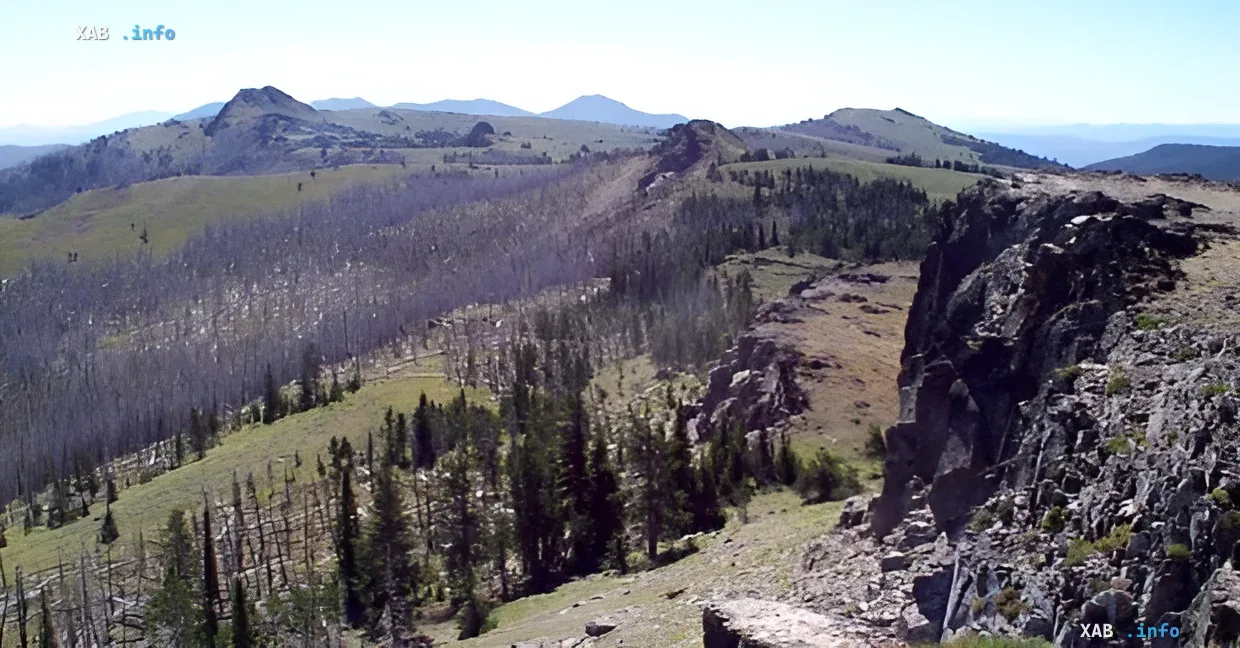
In the Malheur National Forest in Oregon, there hides an entity whose scale makes one forget about whales and sequoias. It is neither an animal nor a tree, but a fungus. Beneath the ground here lies the largest known living organism on the planet. Its weight ranges from 7,500 to 35,000 tons, and its area covers nearly four square miles (about 9.5 square kilometers).
The Mystery of Dying Trees
The story of this giant's discovery began in 1988. Forest pathologist Greg Whipple, working for the US Forest Service, noticed a disturbing anomaly. Firs, pines, and other coniferous species were dying not chaotically, but in whole groups. This pattern did not match the behavior of standard wood diseases. Whipple decided to study the root systems of the dead trees and discovered the true culprit — a parasitic fungus Armillaria ostoyae, known in the folk as the honey fungus.
This species of fungus itself is widespread in the temperate forests of the Northern Hemisphere. However, what Whipple discovered was unique. The fungus in Malheur represents a single organism that has been slowly destroying the forest it inhabits for millennia.
The Underground Empire
What we are used to calling a mushroom is merely the tip of the iceberg. The fruiting bodies of Armillaria ostoyae appear on the surface only in autumn. These are clusters of honey-colored caps growing at the base of infected trees. But the main mass of the organism is underground.
The subterranean part consists of a network of thin white threads — hyphae. They intertwine to form an extensive tissue called mycelium. This mycelium creeps through the soil at a speed of 0.2 to 1 meter per year. To attack trees, the fungus uses special black rope-like structures — rhizomorphs. It is they that penetrate the roots and lead to the death of the forest.
How Scientists Proved It Is One Organism
Until recently, mycologists believed that clusters of fruiting bodies in the forest belonged to different, independent organisms. However, a technique was later developed that overturned this view. Scientists took samples of fungal tissue from different points in the forest and grew them together on Petri dishes.
The logic of the experiment is simple: when samples from different organisms grow next to each other, they recognize each other as "foreign" and form a visible barrier line. If the samples belong to one organism, no barrier arises — the tissues merge into one.
The results were unambiguous: across the entire area of 9.5 square kilometers, the samples merged without barriers. This became proof that the entire population in the Malheur National Forest is one genetic individual.
Age and Uncertainty
Estimating the exact age of this giant is difficult, as direct dating is impossible. Scientists rely on the rate of mycelium spread. The fungus moves through the soil at a speed of 0.7 to 3.3 feet per year. Based on the current area of 2,385 acres and the observed speed, the age of the organism is estimated to be in the range of 2,000 to 8,500 years.
Such a wide range of figures reflects real uncertainty: the rate of spread may have changed over time, and environmental conditions influenced the growth rates. Nevertheless, even the minimum estimate of two millennia makes this fungus the oldest and largest living creature on Earth.
Interestingly, research on fungi continues to bring unexpected discoveries. Previously, scientists found that the common soil fungus Fusarium oxysporum is capable of interacting with gold, literally covering itself with this metal as protection. Nature, as it turns out, holds many more secrets than we can imagine.


