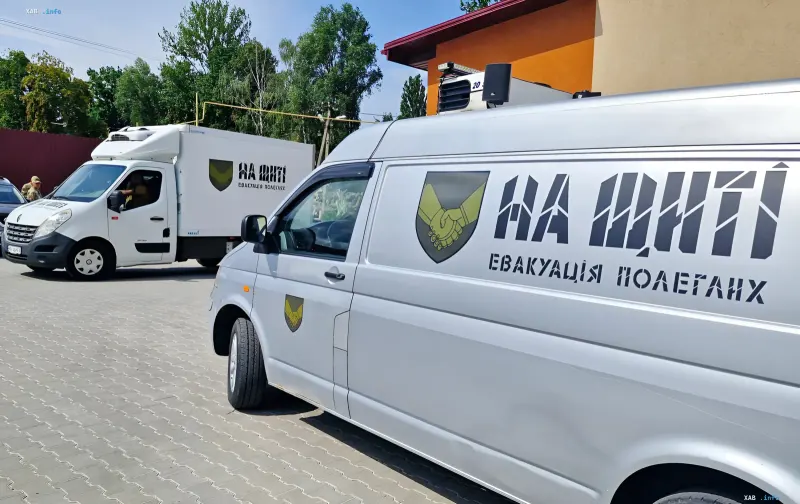
A resonant scandal has erupted in Ukraine surrounding the attempt to register the trademark 'Na Shchite Evakuatsiia Pavshykh' (On the Shield: Evacuation of the Fallen). The designation sounds similar to the name of a well-known humanitarian project of the Armed Forces of Ukraine, which is engaged in the search and evacuation of the bodies of fallen soldiers. The attempt to commercialize or appropriate a symbol that has become part of national memory has caused a wide public outcry and the intervention of regulators.
History of registration attempts and withdrawal of applications
According to the Ukrainian National Office for Intellectual Property and Innovations (UKRNOISI), in 2025, the Public Organization 'Central Military Council' submitted two applications to register the designation 'NA SHCHITE evakuatsiia pavshykh'. The applications received registration numbers m202502514 and m202506457. However, the registration process was not completed. Proceedings on these applications were suspended in July and November 2025. Ultimately, the applicant sent an official message stating that the applications are considered withdrawn.
UKRNOISI emphasized that the trademark under these applications was not registered and cannot be registered. The Office also noted that it does not have the authority to prohibit anyone from submitting trademark applications; however, each application undergoes strict examination for compliance with legislation and the existence of grounds for refusal.
Origin of the symbol and its meaning
The name 'Na Shchite' (On the Shield) began to be used for the humanitarian mission of the Armed Forces of Ukraine back in 2022. The idea to replace the Soviet conventional designation for fallen soldiers, 'Cargo 200', was proposed by veteran and volunteer Leonid Ostaltsev. Volunteer Taty Kepler joined the project's implementation. In August 2022, the General Staff officially announced that the Armed Forces humanitarian project 'EVACUATION 200' had been reformed into the project 'NA SHCHITE'.
According to Taty Kepler, the author's font for the inscription was created by her mother, the artist Marysha Kepler. The volunteer noted that the name arose as a way to speak about fallen defenders not as 'cargo', but as people who return home 'with a shield or on a shield'. Currently, volunteers plan to register copyright on the 'Na Shchite' font and chevron, and then transfer them to the Ministry of Defense.
Contradictory data: who stood behind the applications?
During the investigation, serious disagreements arose regarding the identity of the real initiator of the submission of applications. In the documents, the representative of the PO 'Central Military Council' was listed as Daniil Shmatkov. According to Suspilne, he is a Candidate of Technical Sciences, Associate Professor, and Leading Researcher at the Kharkiv National University of Internal Affairs.
Shmatkov himself categorically denies his involvement in submitting the application. He stated that in 2025 he worked for the company '4B Ukraine', and the documents were allegedly submitted through his personal electronic cabinet without his participation. According to him, he is not the representative of the PO. UKRNOISI confirmed that on August 11, 2026, Shmatkov filed a petition to withdraw the application, as well as a statement on the termination of representation.
The situation is complicated by facts about the applicant organization itself. The PO 'Central Military Council' was registered in Kyiv back in 2015. Its co-founders are listed as Alexander Serafimovich and Eduard Korobov. Both men deny current involvement in the organization's activities. Eduard Korobov, a former resident of Chystiakove (Toretsk) in the Donetsk region, is listed in the 'Mirotovorets' database because, between 2017 and 2021, he allegedly crossed the border with the Russian Federation from the occupied part of the Donetsk region.
Regulator's position and public reaction
UKRNOISI stated that their position on the use of war symbols remains unchanged. 'It is unacceptable to parasitize on the topic of war, military symbolism, the feats of Ukrainian defenders, the memory of the fallen, and socially significant symbols associated with the Russo-Ukrainian war,' the office noted.
At the same time, the legal representation of an application does not in itself mean that the applicant obtains ownership rights to the corresponding designation. In this case, both applications were withdrawn in 2025 and did not lead to the registration of a trademark. Nevertheless, the mere fact of attempting to use someone else's symbol for personal or commercial purposes remains a subject of public condemnation.