
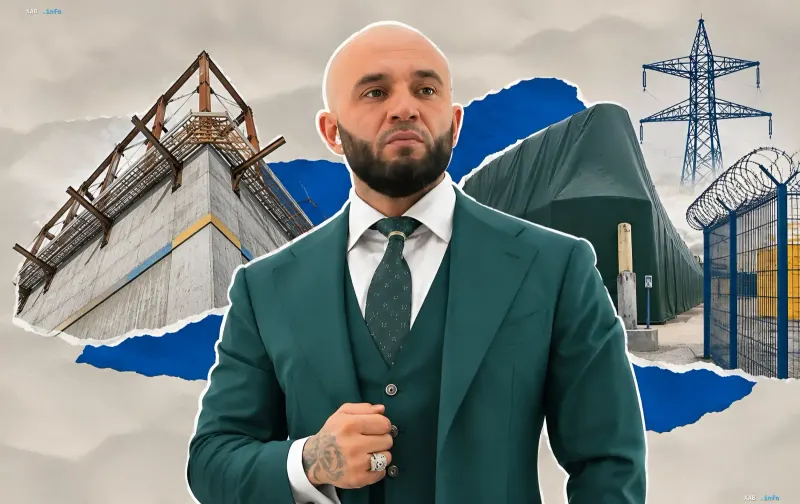
A luxury mansion with marble columns, a fleet of expensive cars, and even his own crocodile — this is how Dnipro entrepreneur Vladyslav Sokolov presented himself in the public sphere when he found himself at the epicenter of a resonant scandal surrounding the construction of protective structures for energy facilities in the Kyiv region. While social media and the media discuss his extravagant lifestyle and the origin of his capital, the businessman himself insists in an interview with RBC-Ukraine that he has become a hostage to the situation: according to him, his companies performed a volume of work significantly exceeding the funding received and have still not received full payment. As a result, Sokolov claims, he was left with multi-million-dollar debts, loans, and personal property transferred as bank collateral.
Who is Vladyslav Sokolov and what did his business do until 2025
According to Sokolov, he has managed Metallurg Trading House for over 24 years — since 2001 — uniting a number of legal entities and specializing in the wholesale trade of rolled metal across Ukraine. The company has its own production base and one of the largest warehouse complexes in Dnipro, where, according to the entrepreneur, about 7,000 tons of rolled metal are constantly stored, and monthly sales amount to 3–4 thousand tons. Until 2025, Sokolov emphasizes, his structures had nothing to do with public procurement and budget contracts. "Given our current experience, we do not plan to have such relations in the future either," he stated, effectively announcing his withdrawal from the public procurement segment.
How a Dnipro metal trader ended up in the Kyiv region energy protection project
According to Sokolov's version, in 2025, Minister for Restoration Oleksandr Kalashnyk personally invited his companies to cooperate for the supply of rolled metal as part of the implementation of the Kyiv Regional State Administration's resilience plan. The entrepreneur noted that acquaintance with Kalashnyk took place back in 2023, when he headed the Darnytsia District State Administration of Kyiv: Sokolov offered rolled metal for municipal enterprises of the district, but cooperation did not take place then. In 2025, according to him, the very ability and readiness to supply products with deferred payment — that is, on credit — became the decisive factor in the choice: other metal traders, including larger ones, refused to work without prepayment, citing compliance policy and high risks.
Credit model of supplies and why other companies refused
Sokolov explained that his business model has always been built on providing payment deferrals: the vast majority of rolled metal supplies are carried out on credit, which makes the company more competitive on the market. The normal accounts receivable of his structures, according to his estimate, is 15–30 million hryvnias, but within the framework of the energy facility protection project, the volume of unclosed obligations, he claims, approached a billion hryvnias. The entrepreneur also said that when looking for concrete suppliers for the same project, he faced mass refusals: as soon as contractors learned that the material was intended for a state facility, they immediately stopped negotiations, fearing subsequent pressure from state bodies.
"Acting on behalf of the president": claims against the minister and risk assessment
In the interview, Sokolov stated that he considered himself acting on behalf of the President of Ukraine, and it was this belief, according to him, that determined the scale of his obligations to the project. He expressed specific claims against Minister for Restoration Oleksandr Kalashnyk, although in the available part of the interview he did not reveal their full list. The businessman emphasized that he considers this story indicative of the entire Ukrainian business community: in his view, the combination of unpaid state obligations, a public scandal, and pressure on property creates a systemic risk capable of frightening private investors away from any cooperation with the state. "Today, a significant part of private business generally does not want to have any relations with the state, even on terms of prepayment," he stated, describing the atmosphere of distrust that, in his opinion, has become the norm for the Ukrainian market.
Context: protection of energy infrastructure and issues of public procurement transparency
The construction of protective structures for energy facilities remains one of the priority areas of Ukraine's state policy against the backdrop of ongoing attacks on the energy system. The Kyiv region, as a region directly bordering the combat zone and Russian territory, is among the most vulnerable. That is why the volumes and timelines for the construction of shelters, dugouts, and protective structures for substations and generating capacities are causing heightened public interest. The scandal around Sokolov fits into the broader context of the discussion on the transparency of public procurement, mechanisms for calculating with contractors, and the responsibility of officials for timely financing. While the position of the Ministry for Restoration and the Kyiv Regional State Administration on the substance of the businessman's claims has not yet been publicly voiced, the story continues to develop and will likely have consequences both for the entrepreneur himself and for the practice of state interaction with the private sector in the field of energy security.


